

Somewhere around the second planning meeting for your charity gala, somebody at the table will say something like, “We’ll put a reserve on the consignment trip and run the fund-a-need straight after the mission moment.”
Half of your committee will nod along while quietly typing those auction terms into Google on their phones under the table. And if that was you, you’re in excellent company. Auction terminology doesn’t come naturally to everybody! I only picked it up myself when I trained as an auctioneer after a career in tech! I know how much a planning meeting can sound like a foreign language the first time you sit through one.
I’ve now called auctions for more than a hundred nonprofits since 2017 and helped raise over $22 million from the stage. I can tell you the vocabulary matters for more than keeping up in meetings.
A committee that’s fuzzy on what a reserve is or a fair market value really means can agree to something that costs the organization real money on the night. So this is the glossary I wish every auction chair was handed on day one, written for a fundraising room instead of an art house or a real estate sale.
I’ve grouped the terms by where you’ll hear them during the evening and put them in alphabetical order inside each group. If you only came for one word, the A to Z list below will take you straight to it.
A to Z List of Charity Auction Terms
AAcknowledgment letter · Activation
BBenefit auctioneer · Bid increment · Bid sheet · Bid spotter · Blackout dates · Buyer’s premium · Buy-it-now price
CChant · Consignment company · Consignment item
FFair market value · Fair warning · Fund-a-need
LLive auction · Lot
MMatching gift · Max bid · Mission moment · Mobile bidding
PPaddle · Paddle raise · Priceless item
The Auction Itself
Most galas use more than one kind of auction in the same evening, and it helps to know which is which before you start deciding where each item belongs. In my rooms the live auction is always the centerpiece, with the silent and online auctions warming guests up for it.
Live Auction
A live auction is an auction where an auctioneer sells items one at a time from the stage while guests bid against each other in real time, usually by raising a numbered paddle. That’s where the biggest bids of the night tend to happen. A room watching two bidders go back and forth creates energy that a clipboard or phone screen can’t match. I’ve written more about how silent and live auctions compare.
Online Auction
An online auction is an auction that runs on a web-based bidding platform, where supporters browse the items and place bids from any device, wherever they happen to be. It often opens several days before the gala, which lets people who can’t attend still take part and gets the bidding moving before the doors open. The tool guests use to place those bids is called mobile bidding, which has its own entry further down.
Silent Auction
A silent auction is an auction where guests bid in writing or on their phones instead of out loud, usually during cocktail hour, with each item going to the highest bidder when the auction closes. It suits lower-priced items and gives guests an easy way to start spending early, which makes it a very good opening act for the live auction. If you’re new to all of this, start with what a charity auction is and how it works.
Who’s in the Room
A good auction night takes a small team, and committees are often surprised to learn how many of these roles are separate jobs.
Benefit Auctioneer
A benefit auctioneer is a professional auctioneer who specializes in fundraising events for nonprofits, as opposed to selling cattle or real estate. You’ll also hear “charity auctioneer” and “fundraising auctioneer,” which mean the same thing. The job starts long before the night itself, with advice on which items to sell and how to build the program around them. At Biddy Up, I work for a flat fee based on the size of the audience and the location of the event, so what I’m paid never depends on taking a percentage of what your room raises. Here’s more on what a charity auctioneer does during an event.
Bid Spotter (Ringman, Bid Assistant)
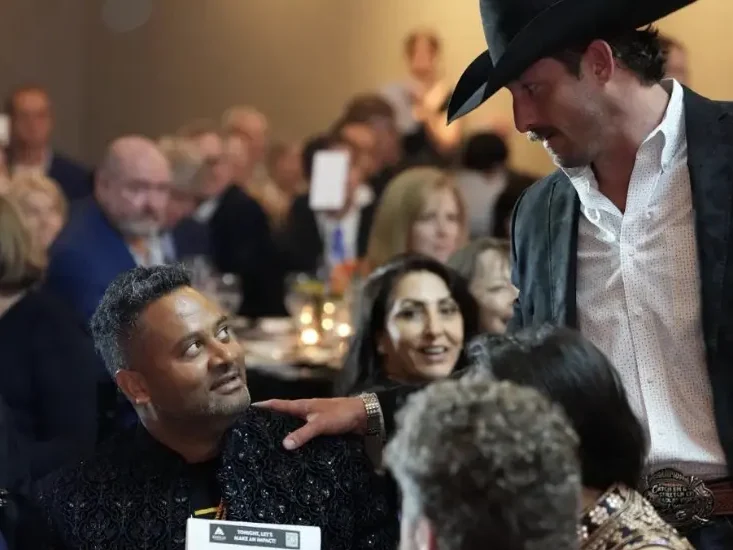
A bid spotter is a member of the auction team who works the floor during the live auction, catching every raised paddle and signaling it to the auctioneer so that no bid is missed. In a ballroom of three hundred people I can’t see every table from the stage, particularly the ones at the back, and a bid I miss is money the nonprofit never receives.
Spotters also do a job that’s harder to see from your seat, which is standing beside a bidder who’s wavering and giving them a grin and a little encouragement to go one more. I bring my own team to every event, and you’ll know them when you see them, because my cowboy spotters come from Texas with the hats to prove it. They’re a big part of why the room feels like a party while it’s giving. A trained spotter is doing something quite different from a volunteer who’s been asked to point at paddles, and in my experience it shows in the final total.
Consignment Company
A consignment company is a business that supplies auction items to nonprofits at a set cost, most often travel packages and experiences. The nonprofit offers the item in its auction and, in most arrangements, only pays the company if the item sells, keeping whatever was bid above that cost. It’s a useful way to add a headline trip to your auction when nobody on the committee happens to own a villa. The consignment item entry below explains how the money works.
Emcee
An emcee is the host who guides guests through the evening’s program, introducing the speakers and keeping the night on schedule. Committees often assume the emcee and the auctioneer are the same person, but hosting a program and selling from the stage are different skills. I’m there purely as your auctioneer, so plan on a separate host to carry the rest of the evening. My post on building a charity gala program covers how the pieces fit together.
Pricing and Value
These are the terms with the most money attached to them, and they’re the ones I most often find a committee has agreed on without everyone meaning the same thing. I go deeper into the numbers in how to price charity auction items.
Bid Increment
A bid increment is the minimum amount by which each new bid must be higher than the last one. If the bidding stands at $1,000 and the increment is $100, the next bid has to be at least $1,100.
In a live auction I set the increments from the stage, usually moving up by 10 to 20 percent of the previous bid, and I’ll adjust them as I go depending on how fast the paddles are moving. In a silent auction the increment is fixed in advance and printed on the bid sheet or built into the bidding platform, typically at around 10 percent of the item’s fair market value. Increments that are too small make an auction drag, and increments that are too big can stop the bidding cold.
What Is a Buyer’s Premium in an Auction?
A buyer’s premium is a percentage fee added on top of the winning bid, paid by the buyer and kept by the auction house. If you win a painting with a $1,000 bid at an auction house that charges a 20 percent buyer’s premium, you’ll pay $1,200. It’s standard practice at commercial sales, and it’s how those auction houses earn part of their income. The rate depends on what’s being sold, and AuctionMethod’s guide to buyer’s premiums puts typical figures at 5 to 10 percent for real estate, rising to 20 to 28 percent for art and antiques.
You’re unlikely to meet one at a fundraising gala. At my auctions, the guest pays what they bid, and because I work for a flat fee, nothing gets added to anyone’s paddle on my account. The closest thing you’ll see at most charity events is an optional box at checkout inviting guests to cover the credit card processing fee, so that the full amount of their bid goes to the cause.
Buy-It-Now Price
A buy-it-now price is a set amount at which a guest can purchase a silent auction item outright and end the bidding on it. It’s there for the guest who wants the item enough that they’d rather not spend the evening checking their phone. I usually set it at 150 to 200 percent of fair market value, which is high enough that the nonprofit is delighted to take it.
Consignment Item
A consignment item is an auction item supplied by a consignment company at a set cost instead of being donated. The nonprofit keeps the difference between that cost and the winning bid, so a trip with a consignment cost of $3,000 that sells for $5,000 raises $2,000 for the cause.
That’s why consignment items are priced differently from donated ones. I open the bidding at 100 to 120 percent of the cost, because any sale below it would lose the organization money. They earn their place when they bring something exciting that your own donor community couldn’t provide, and many of them can be sold more than once in the same night. My guide to the best live auction items has examples.
Fair Market Value
Fair market value is the price an item would sell for on the open market, outside the auction. For a restaurant gift card that’s the face value, and for a week in a rental home it’s what the owner would normally charge.
The number does two jobs at a charity auction. It gives us the starting point for pricing the item, and it determines how much of a winning bid the buyer can treat as a charitable gift, which I explain in the tax section below. That second job is the reason every item in your catalog should show a value.
What Does No Reserve Mean in an Auction?
No reserve means an item will sell to the highest bidder whatever the final price turns out to be, with no minimum the bidding has to reach. You’ll also hear it called an absolute auction. At a commercial sale that’s a real risk for the seller, which is why “no reserve” gets advertised to draw a crowd. At a fundraiser it’s far less frightening, because a fully donated item cost the nonprofit nothing, so every dollar bid on it is a dollar raised.
Priceless Item
A priceless item is an auction item with no retail equivalent, usually an experience that money can’t normally buy, such as a backstage visit or a dinner cooked in your home by a well-known chef. These are often the lots that spark the fiercest bidding, because nobody in the room can talk themselves out of it by looking up the price. The nonprofit still provides a good-faith estimate of the value for the paperwork.
What Is a Reserve in an Auction?
A reserve is the lowest price at which an item can be sold, agreed in advance between the seller and the auctioneer. If the bidding doesn’t reach the reserve, the item isn’t sold. Bidders usually aren’t told the figure, although they may be told that a reserve exists.
At a charity auction, reserves matter most on consignment items. Every consignment piece I sell carries one, because the nonprofit has to clear the consignment cost before it has raised a single dollar. On donated items, I talk through any reserve with the nonprofit ahead of the event, based on the value that item needs to reach in the room, and when we do set one it tends to sit between 15 and 25 percent of fair market value.
After that, it’s my job to know what the item is worth and to get the room excited enough that the reserve is a distant memory by the time I say “sold.” If an item ever does stall below its reserve, I simply close the bidding without a sale and move on to the next lot.
Starting Bid
A starting bid is the amount at which bidding on an item opens, also called the opening bid or minimum bid. Set it too high and nobody raises a paddle, while a comfortably low opening gets several people in at once, which is how a bidding war begins. For live auction items I usually open at 35 to 50 percent of fair market value, and for silent auction items at 50 to 70 percent, because a silent auction has less time and less theater to push a price upward.
Live Auction Terms You’ll Hear From the Stage
This is the part of the night that moves fastest, and the handful of words below will help a first-time guest follow what’s happening.
Chant
The chant is the fast, rhythmic patter an auctioneer uses to call out the current bid and ask for the next one, with filler words keeping the rhythm in between. It’s a trained skill that I learned at auctioneer school, and I know it can be intimidating to hear if you’ve never been to an auction, because at full speed the numbers are easy to lose. I work very hard on my enunciation for exactly that reason, so that every guest in the room can follow where the bidding stands and feel confident enough to raise a paddle. My post on the auctioneer chant explains how it works.

Double Sale
A double sale is when the same item is sold twice, once to the winning bidder and once to the runner-up. If two guests have fought hard over a trip and the donor or consignment company can provide a second one, I’ll offer it to the runner-up, known as the underbidder, right there from the stage, while one of my cowboys heads over to their table to confirm the yes. Making the offer in front of the whole room means it arrives with a round of applause already behind it, and that warmth makes it a very easy thing to say yes to. It can double what an item raises in about thirty seconds, which is why I ask about it for every package before the event.
Fair Warning
Fair warning is the auctioneer’s last call before an item is sold, giving anyone still thinking about it a final chance to bid. It’s the moment you know from the movies as “going once, going twice.” When you hear me say it, I mean it, so that’s the time to get your paddle in the air.
Lot
A lot is a single item or package sold as one unit in an auction, and each one is given a lot number so it’s easy to follow in the program. The full list of lots is called the catalog. A charity live auction works best with a short one, and I recommend five to nine lots for most galas.
Paddle
A paddle is the numbered card a guest raises to place a bid, and the number printed on it is their bidder number. That number is tied to the guest’s name and payment details at registration, so raising it is a real commitment to pay. The same paddle comes out again for the paddle raise later in the evening.
Silent Auction Terms
The silent auction supports the live auction by getting guests comfortable with spending early, and most of its vocabulary now comes from bidding apps.
Bid Sheet
A bid sheet is the paper form placed beside a silent auction item where guests write their bidder number and the amount they’re bidding. It should show the item’s name, its fair market value, the starting bid and the bid increment. Many events have replaced paper sheets with mobile bidding, although plenty of smaller ones still use them happily.
Max Bid
A max bid is the highest amount a guest is willing to pay for an item, entered privately into a mobile bidding platform. The platform then bids on the guest’s behalf, one increment at a time, going only as high as it needs to in order to keep them in the lead. It’s also called proxy bidding or auto-bidding, and it’s a kindness to guests who would like to enjoy their dinner.
Mobile Bidding
Mobile bidding is a system that lets guests place bids from their own phones through a link or a QR code, without paper bid sheets. The platform sends a text when someone has been outbid, which keeps people bidding from the dinner table and even from home. It’s the tool that makes an online auction possible, and it’s used for silent auctions inside the ballroom too.
Soft Close
A soft close is a closing rule that extends the bidding on an item by a few minutes whenever a bid arrives right before the deadline. It stops a guest from winning by slipping in a bid in the final second, and it gives the competition time to answer. Some platforms call it extended bidding or overtime.
Giving Moments
Bidding is only one part of what a gala raises. These are the moments built around direct giving and a little friendly fun, and most of them have a full guide of their own on this blog.
Activation
An activation is an interactive station or experience that gives guests something to do, and often something to buy, before the auction begins. A custom hat bar and a monogramming station are both good examples. Done well, activations get people involved early and give sponsors something far better than a logo in the program. I’ve written about how activations set up a bigger auction night.
Fund-a-Need
A fund-a-need is a direct appeal in which guests raise their paddles to give at set dollar amounts toward one specific project or program, without receiving anything in return. You’ll also hear it called a Paddle Raise too. Guests can picture exactly what their gift pays for, which often makes it the most generous few minutes of the whole evening.
Giving Levels
Giving levels are the dollar amounts the auctioneer calls out during a paddle raise or fund-a-need, starting at the top and working down. A typical sequence might open at $10,000 and step down through $5,000, $2,500 and $1,000 until it reaches $100, although the right levels depend entirely on the room.
Heads or Tails
Heads or tails is a coin-toss elimination game that guests pay to enter, usually by buying a wristband or a beaded necklace during cocktail hour. Everyone playing stands up and guesses each flip by putting their hands on their head or on their behind. A wrong guess means sitting down, and the game carries on until the last guest standing wins the prize. It takes about five minutes and wakes the room up right before the live auction. Here’s how to run heads or tails.
Matching Gift
A matching gift is a pledge from a sponsor or donor to match what guests give during the paddle raise, up to an agreed amount. It’s also called a challenge match. Announcing that every dollar will be doubled is one of the most reliable ways I know to lift more paddles at every level. I’ve written about how a matching donation challenge works.
Mission Moment
A mission moment is the point in the program where the evening pauses to show guests, in human terms, what their giving makes possible. It’s often a short video or a few words from someone the organization has helped, and about three minutes is plenty. I place it right after the live auction and just before the paddle raise, so the cause is front of mind at the moment the room is asked to give. I’ve shared how to plan a mission moment.
Paddle Raise
A paddle raise is a fundraising moment where guests give directly to the cause by raising their paddles, instead of bidding on an item. You’ll hear it called “paddles up” too. People often use the name interchangeably with fund-a-need, and the difference is that a fund-a-need is tied to one specific project, while a paddle raise can support the organization’s work more generally. My full guide explains what a paddle raise is and how to run one.

Raffle
A raffle is a game of chance in which guests buy tickets and a winner is drawn at random for a prize. Raffles are regulated differently from auctions and the rules vary from state to state, so check yours before you add one to the program.
Wine Pull
A wine pull is a fundraising game where guests pay a flat price to choose a bottle of wine at random, without knowing what they’ve picked until they’ve paid. Most bottles are worth about what the guest paid, and a few are worth far more. It’s also called a wine wall. Here’s how to run a wine pull.
After the Auction
Two more terms tend to come up once the paddles are down, and both are worth knowing before you bid.
Acknowledgment Letter
An acknowledgment letter is the written receipt a nonprofit sends after the event, showing what a guest paid and a good-faith estimate of the value of anything they received for it. Guests need it for their tax records, and you’ll also hear it called a tax receipt.
Blackout Dates
Blackout dates are the dates on which a travel package or experience can’t be used, typically holidays and peak season. Along with the expiration date, they’re the detail a winning bidder most often wishes they’d read first. Put them clearly in the item description, which I cover in how to write auction item descriptions that sell.
Charity Auction Tax Deduction: How It Works When You Win an Item
Guests ask me about the charity auction tax deduction all the time, usually right after they’ve won something. The rule from the IRS is that a winning bidder can deduct only the amount they paid above the item’s fair market value. If you paid more than the item is worth, the extra is your charitable gift, and if you got a bargain, there’s nothing to deduct.
| What happened | What may be deductible |
|---|---|
| You paid $1,000 for an item with a fair market value of $600 | $400 |
| You paid $500 for an item with a fair market value of $600 | $0 |
| You gave $1,000 in the fund-a-need and received nothing in return | $1,000 |
Two things follow from that rule. The first is that the IRS expects the buyer to be able to show they knew the item’s value was lower than what they paid, and a catalog that lists a good-faith value for every item is the simplest way for a nonprofit to help with that. The second is paperwork. When a guest pays more than $75 and receives something in return, the nonprofit has to give them a written statement of how much of the payment is deductible, and a donor needs a written acknowledgment to claim any single gift of $250 or more.
Committees also get asked what the people who donate items can deduct, and the answer surprises a lot of them. According to IRS Publication 526, donating a week at your vacation home to an auction isn’t deductible, and neither is the value of your time or services. For donated goods, the deduction is generally limited to what the donor paid for the item, whatever it goes on to sell for.
I’m an auctioneer and I’m no tax adviser, so please treat this as an overview and send your guests and donors to their accountant for anything specific to them.
Not Sure What Your Committee Just Agreed To?
If a word came up in a planning meeting and nobody around the table was completely sure what you’d all signed up for, that’s a very good reason to get in touch. I’d love to hear about your event and talk it through in plain English before anything gets signed.
Where auction performance meets purpose
Plan Your Auction With Someone Who Speaks the Language
Biddy Up helps nonprofits plan and run charity auctions for a flat fee, with a professional auctioneer and our own cowboy spotters working your room.
Start the Conversation Explore Services