
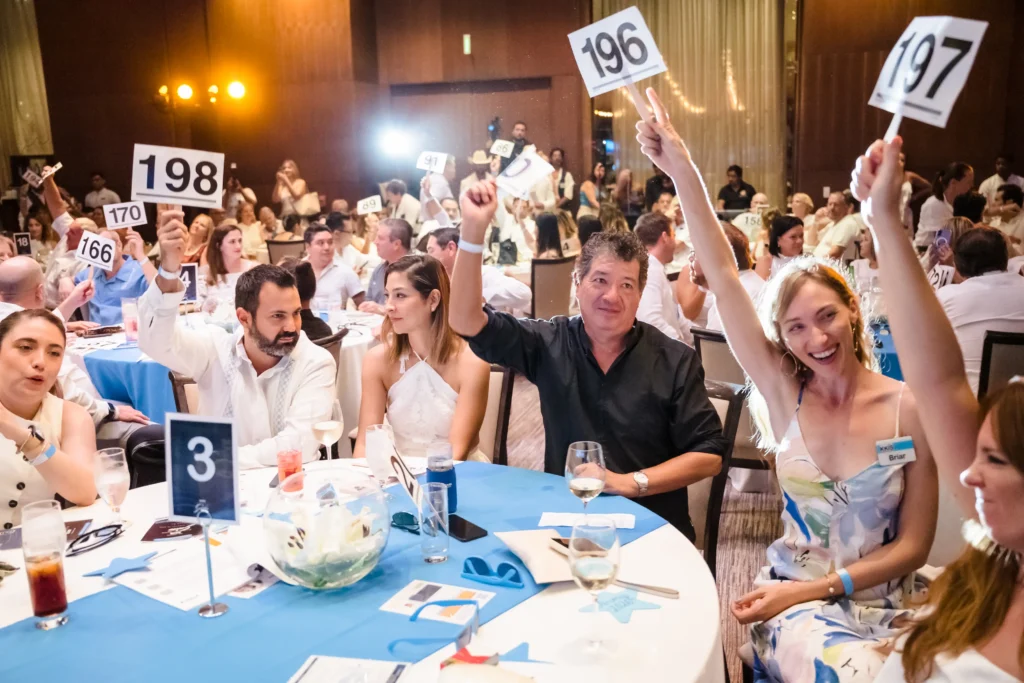
Charity auctions are one of the most effective ways for nonprofits raise much needed money.
At their simplest, they are events that bring people together to bid on items or experiences, with proceeds going toward a cause. You’ll often see them at galas, fundraising dinners, school events, and corporate charity nights.
But while the concept is straightforward, the results are not. Two events can run what looks like the same auction — similar items, similar audience — and raise completely different amounts. One feels energetic, competitive, and successful. The other feels polite, with limited bidding and flat results. That difference comes down to how the auction is structured.
Before getting into that, it helps to understand how charity auctions actually work.
What Is a Charity Auction?
A charity auction is a fundraising activity where guests bid on items, services, or experiences, with the proceeds supporting a nonprofit or cause.
Unlike traditional auctions, the goal isn’t just to sell something at market value. It’s to create an environment where people are motivated to give — often bidding above what they would normally pay because they’re supporting something meaningful.
These auctions are typically part of a larger event, such as a gala or fundraiser, where they sit alongside dinner, entertainment, and speeches.
On the surface, it’s simple: items are donated, guests bid, and money is raised. In practice, how those bids are generated is where the real difference lies.
The Three Main Types of Charity Auctions
Most fundraising events use one, or a combination, of the three types of auction: silent, online and live.
Understanding the difference between these three matters, because each one drives a different kind of participation — and different results.
Silent Auctions
In a silent auction, guests browse items which are displayed and place bids either on paper sheets or through a mobile bidding platform. They usually open early in the event, while people are arriving, getting drinks, and finding their tables. It’s low-pressure and easy to engage with.
Why they work:
- Simple to set up
- Easy for guests to participate in casually
- Good for getting people involved early
Where they fall short:
- Limited urgency
- Lower competition per item
- Bids tend to plateau
Silent auctions are effective at getting people to start bidding — but on their own, they rarely drive the highest revenue.
Online Auctions
Online auctions run through a digital platform, allowing guests to browse and bid from their phones — either during the event, before it, or entirely separately, as an online only event.
In some cases, they can replace a traditional silent auction. In others, they run alongside it, removing the need for paper bid sheets, and having guests bid on the online bidding platform instead.
Why they work:
- Guests can browse and bid in advance
- Easier to manage large numbers of items
- Extends participation beyond the room
- Gives immediate feedback to bidders and options to pay
Where they fall short:
- Less visible competition
- Lower energy compared to live bidding
- Reliant on tech, signal, and user experience
The key difference with online auctions is timing. If the catalogue opens before the event, guests arrive already knowing what they want to bid on. That can increase participation early on. But, as with any software or online tool working it out and having guests log-in and have wi-fi signal can create its own preblems.
Live Auctions
In a live auction, items are presented one at a time by an auctioneer, with guests bidding in real time — usually by raising paddles. This happens when the room is seated and focused, typically after dinner or during the main part of the program.
Why they work:
- High energy and visibility
- Real-time competition
- Ability to push bids beyond expected value
The key difference here is the way a live auction is perceived in the room. People see each other bidding. They react. The energy builds. That’s what drives prices up — not just the item itself.
This is where most events generate their biggest fundraising moments. Especially when they choose a valued and trained professional auctioneer to host it.
How These Formats Work Together
Most high-performing events don’t rely on just one format.
They use:
- silent or online auctions to build early participation
- live auctions to convert that engagement into higher-value bids
Each format plays a role. Silent and online auctions get people involved. Live auctions create the pressure that drives revenue and helps you to get bigger value on your high-ticket items.
Choosing the right format — or combination — isn’t just a logistical decision.
It directly affects:
- how many people participate
- how competitive the bidding becomes
- and ultimately, how much you raise
Because charity auctions don’t just depend on what you offer. They depend on how people experience the opportunity to bid.
How a Charity Auction Actually Raises Money
At a basic level, charity auctions work because items are donated, meaning the funds raised go directly to the cause. But that’s only part of the picture. The real driver of revenue is competition.
When multiple people want the same item, the price increases. That increase isn’t just about value — it’s about emotion. Guests are influenced by the energy in the room, the cause they’re supporting, and the presence of other bidders.
That’s why the environment matters. A well-run auction creates urgency, visibility and momentum. Without those elements, even strong items can underperform.
What Happens at a Charity Auction Event
While every event is slightly different, most follow a similar structure. Guests arrive and the silent auction opens. This is where early engagement begins — people browse, place initial bids, and start to interact with the auction.
As the event progresses, attention shifts. Guests are seated, they may have dinner, the program begins, and the focus moves toward the live portion of the evening.
The live auction then takes over. Items are presented one at a time, with bidding happening in real time. This is where energy builds, and where larger bids typically occur.
Many events also include a fund-a-need or raise the paddle moment — where guests donate directly to the cause without receiving an item. This is often one of the most impactful parts of the night, and a great way to boost income without needing to have auction prizes.
The Role of a Professional Auctioneer
In a live auction, the auctioneer is not just presenting items — they are shaping the entire experience of the night.
They control pacing, and read the room. They’ll be aware of who your high-bidders are and where they are sat. They’ll know when to push for an extra bid, pause, or shift direction. They understand how to build momentum and how to keep bidders engaged.
Without that, even a strong audience can fall short of their bidding potential.
With the right auctioneer, the same room can feel completely different — more responsive, more competitive, and ultimately more generous. This is often where events see the biggest difference in results.
Common Mistakes First-Time Event Planners Make
Many underperforming auctions share the same patterns.
Treating the auction as a side activity is one of the biggest mistakes you can make. When it’s not integrated into the flow of the event, it loses importance.
Too many items are another common issue. It spreads the attention of your guests thin and reduces competition.
Poor transitions between silent and live elements can also break momentum, making it harder to re-engage the room.
Most of these mistakes aren’t obvious during planning — but they show up clearly on the night.
Final Thought: A Charity Auction Is Not Just an Activity — It’s the Revenue Driver
At many fundraising events, the auction is treated as one part of the evening. In reality, it’s where the majority of income happens.
When structured well, it creates engagement, builds momentum, and drives significant contributions. When it isn’t, even a well-attended event can fall short of its potential.
If you’re planning a charity event, the structure of your auction is what determines how much you raise.
Biddy Up works with organizations to turn auctions into high-performing fundraising moments. Contact us today to see how we can support you with your next event.
Where auction performance meets purpose
Understanding how auctions work is one thing — making them perform is another.
Biddy Up helps nonprofits design and run auctions that drive real engagement, stronger bidding, and better fundraising results — from strategy through to live auction performance.
Start the Conversation Explore Services