
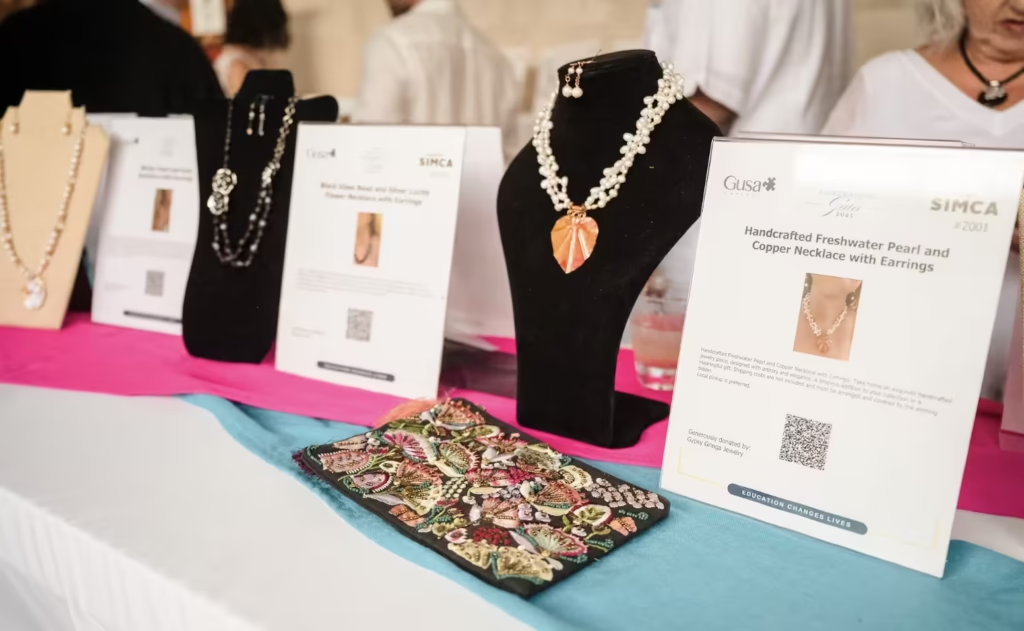
Silent auctions should be one of the easier parts of your charity gala. Guests browse the items, place their bids and, with any luck, spend a little more than they planned. Without clear rules, though, the silent auction tables are where the evening’s small arguments start. Whether it is two guests who are both certain they’ve won the same item or someone adding a bid after the sheets were meant to be collected.
I’ve worked with more than a hundred nonprofits since 2017, and my advice is always to keep your silent auction rules simple and post them where every guest can see them. Below are the rules I recommend, along with a printable template you can use at your next event.
What Are Silent Auction Rules?
Silent auction rules are the terms that explain how guests place bids, when bidding closes, how winners are decided, and how they pay for and collect their items.
If you’re new to the format, the question I hear most is “How does a silent auction work?” Guests browse the auction items, which are usually out on display, and write their bidder number and bid amount on the sheet beside each one. Some auctions allow you to place bids through an app if they are using mobile bidding. When bidding closes, the highest valid bid wins.
In my rooms, the silent auction is always the opening act, getting guests participating early so they’re warmer bidders by the time the live auction starts. I explain more about how the two formats work together in Silent Auction vs Live Auction: Which Raises More Money?.
9 Silent Auction Rules Every Charity Gala Should Set
You don’t need pages of complicated terms and conditions, just a few clear rules that cover the situations most likely to cause confusion. These are the nine silent auction bidding rules I’d recommend establishing before your event.
1. Register Before You Bid, and Bid With Your Bidder Number
Every guest needs to be identifiable when they place a bid, so assign bidder numbers at check-in and link them to each guest’s contact and payment details. That number then goes on the bid sheet rather than their name.
Names alone can get confusing, especially when you’re trying to decipher handwriting in a dimly lit ballroom after the third glass of wine. And when you’ve got two guests called Jennifer sitting at neighboring tables, you might have a problem working out which Jennifer actually won.
Bidder numbers do need a little care, because guests forget them or borrow their partner’s. Make sure your registration team keeps an accurate record and that every guest can check their number easily, ideally on a card they’re handed at check-in.
If you’re using mobile bidding, guests will usually register through the platform, which connects their bids to their account. Depending on the software and your event settings, you may also be able to collect payment details in advance to make checkout easier.
2. Set Starting Bids and Minimum Increments
Every item needs a starting bid and a minimum increment. The starting bid is the lowest amount someone can offer, while the increment is the minimum amount each new bid must increase by.
For example, a gift basket worth $100 might have a starting bid of $60 and a $10 increment. If the current bid is $80, the next guest must bid at least $90. They can offer $100 or $120 if they want, but $85 wouldn’t count.
I approach silent auction pricing differently from live auction pricing. On stage, I can build momentum and encourage guests to keep bidding. A silent auction item doesn’t have an auctioneer standing beside it doing that work, so the starting bid needs to make sense on its own.
For silent items, I suggest setting the starting bid at 50 to 70 percent of fair market value and the increment at roughly 10 percent of fair market value. That’s higher than I’d open a live item, which I usually start at 35 to 50 percent. Whatever amounts you settle on, print them clearly on each bid sheet so guests aren’t left guessing how much to raise their bid.
I cover the pricing process in more detail in How to Price Charity Auction Items.
You can also offer a buy-it-now price on selected items, usually 150 to 200 percent of fair market value, allowing someone to purchase the item immediately rather than continue bidding. Just make sure the price and the process for claiming it are clearly explained.
3. Write Clearly, and Never Change Someone Else’s Bid
For paper auctions, each new bid should go on the next available line and be easy to read. Guests shouldn’t cross out, overwrite or alter existing bids, including their own, and your rules should say that illegible or altered bids may be rejected so volunteers have a consistent policy to follow.
If someone makes a genuine mistake, they should speak to the auction chair or head clerk rather than trying to fix the sheet themselves. It’s a simple rule, but it saves a lot of arguments once bidding gets competitive.
4. Close Bidding at a Fixed, Posted Time
Choose an exact closing time and stick to it. Vague instructions such as “after dinner” invite arguments about whether a bid made it in time, and extending bidding at the last minute, unless your published rules allow for it, teaches guests that the posted time doesn’t really mean anything.
For paper bid sheets, have your auction clerks collect the sheets at the stated time, and anything added after closing doesn’t count. If you’re using mobile bidding, check whether your platform offers a soft close, which extends bidding for a short period when a last-minute bid comes in so other guests have a chance to respond. It’s useful for competitive items, as long as guests know about it in advance.
Closing reminders matter more than most committees expect. In BetterUnite’s analysis of nearly 400 spring 2026 auctions, 23% of all silent and online bids came in during the final hour, and 31% of revenue landed in that same hour. People really do leave their bidding until the last minute, and your job is to make sure they know exactly when that last minute is.
5. Decide How Ties and Disputes Are Settled
In theory, two identical bids shouldn’t happen on a paper bid sheet, because every new bid has to beat the last by the minimum increment. Mistakes do happen in practice, so if two guests write the same amount, accept the bid that appears first on the sheet, provided it’s valid, and say so in your rules before bidding begins.
Mobile platforms usually timestamp each bid and refuse one that doesn’t beat the current highest amount, but it’s worth checking how yours handles simultaneous bids.
You also need someone with the authority to settle disagreements. Name an auction chair or head clerk before the event and make sure every volunteer knows who that person is, and state on your rules sign that their decision on bidding disputes is final. Without that, a dispute ends up with three volunteers offering three different answers, and a thirty-second disagreement becomes the thing two of your best donors remember about the evening.
6. Make It Clear That Bids Are a Commitment
Guests should understand that placing a bid means agreeing to buy the item if they win. I recommend a policy that bids can’t be withdrawn without approval from the auction chair and that completed sales are final, subject to applicable law and any exceptions stated in your terms. Without it, you risk someone winning an item and then deciding they don’t want it, leaving your nonprofit to chase payment or find another buyer.
If a guest has made a genuine mistake, deal with it quietly and let your designated auction official decide how to handle it.
7. Winners Must Pay Before Collecting Their Items
Your rules should explain when payment is due and how guests can pay, along with what happens if someone doesn’t. I recommend collecting payment details at registration where practical. Some mobile bidding platforms charge winning bidders automatically while others ask guests to complete checkout themselves, and with paper bidding you’ll need a system for matching winning bids to guests and processing their payments. Either way, make it very clear that items cannot be collected until payment has been confirmed.
Decide before the event what happens if a winner leaves without paying. My recommendation is to contact them the following morning with a clear payment deadline, and if they still don’t pay, your published terms can allow you to offer the item to the next-highest bidder at that bidder’s original amount.
A quick note on tax receipts: Make sure winners receive a record of their purchase, including the amount paid and the item’s fair market value. For qualifying charity auction purchases, the amount paid above fair market value may be tax-deductible. The IRS also requires nonprofits to provide written disclosures for certain payments over $75 that are partly a donation and partly a purchase.
Your nonprofit should have the appropriate receipt and disclosure process in place before the event rather than leaving volunteers to explain tax rules at checkout.
8. Explain When and Where Guests Can Collect Their Items
Winning an item is an exciting experience, but finding out where to collect it shouldn’t turn into a treasure hunt. Tell guests exactly where and when pickup will happen, and what they need to show to collect their purchase.
At my events, I recommend that the collection area remains closed until the live auction and paddle raise have finished. You don’t want guests queuing for gift baskets while I’m raising money from the stage.
When it does open, have volunteers check receipts or payment confirmations before releasing any items.
Travel packages and experiences may need to have their certificates sent after the event, and large items may need a delivery arrangements to be made. Set a policy for unclaimed items too, because you don’t want to spend the next three months storing uncollected gift baskets.
9. Clearly Explain Restrictions and Item Conditions
Some auction items come with conditions that guests need to understand before bidding. Travel packages often carry blackout dates and restaurant certificates can expire, and those details belong in the item description rather than in a surprise email after someone has won. For physical items, explain whether they’re sold as-is and whether guests should inspect them before bidding. You should also reserve the right to withdraw an item before bidding closes if it becomes unavailable or there’s a problem with the donation.
Alcohol items need particular care. Follow the applicable state and local rules, including minimum-age requirements, and check your venue’s policies. Auction and alcohol regulations vary by location, as do the rules on raffles, so your nonprofit should confirm the relevant requirements before finalizing its terms.
Printable Silent Auction Rules Template
You don’t need to write your silent auction rules from scratch. Here’s a simple template you can copy and adapt for your next fundraising event. Make the closing time impossible to miss, and cut anything that doesn’t apply to your auction.
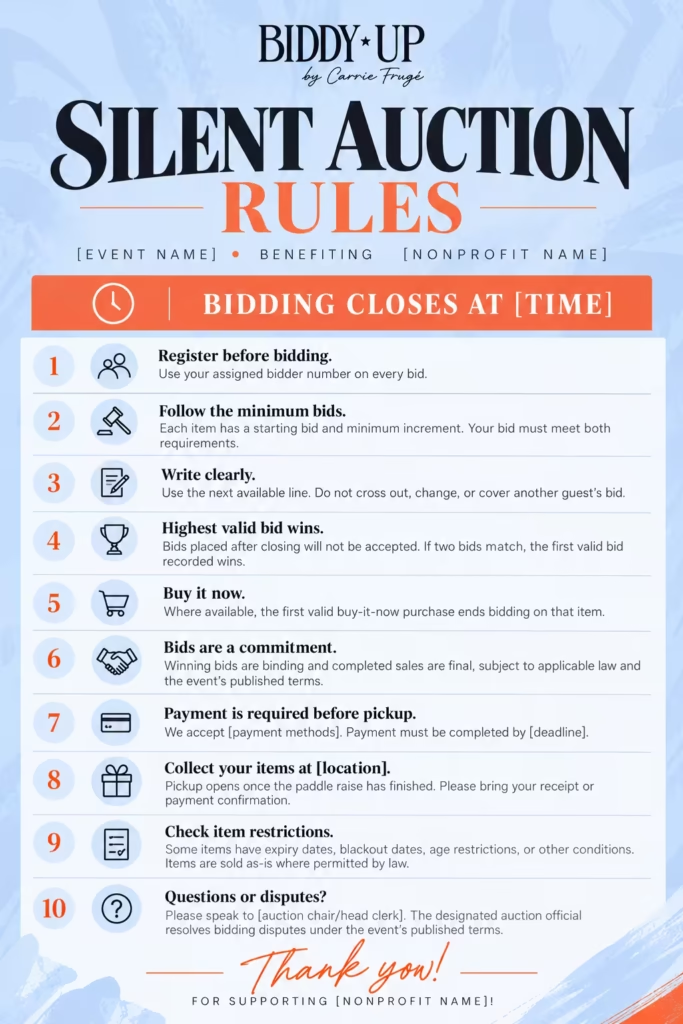
You can also print a shorter version at the bottom of every paper bid sheet:
Bidding closes at [time]. Use your bidder number. Follow the starting bid and minimum increment shown. Highest valid bid at closing wins. Payment is required before collection.
For mobile bidding, adjust the template to explain how guests register, how the platform handles closing times, and whether payment is processed automatically.
If you’re using both paper and mobile bidding, make sure the rules explain which system applies to each item. You don’t want guests trying to place paper bids on items that are only available through an app.
Where to Post Your Silent Auction Rules
Having good rules is only half the job, because guests also need to see them at the moments they’re deciding to bid. I recommend displaying your silent auction rules in several places throughout the event.
Before the event: Include the rules in your ticket confirmation email or event information. If you’re using a mobile bidding platform, add them to the auction page where possible.
At check-in: Make sure guests know how to register and bid. If you’re assigning bidder numbers, a small card with their number on the front and basic bidding instructions on the back can work well.
At the silent auction tables: Place a printed rules sign somewhere guests can easily read it. If you have several tables, display the rules in more than one location. The closing time should be particularly prominent.
On every bid sheet: Include the essential instructions so guests don’t have to search for another sign. For more detail on setting these up, see our guide to silent auction bid sheets.
From the stage: Your MC should give closing warnings very often, far more often than feels natural to whoever is holding the microphone. This matters most with written bid sheets and online bidding, because once dinner arrives guests drift away from the tables and their phones go back in their pockets. I’m the auctioneer rather than the emcee, so I ask the MC to keep reminders coming through dinner and to step them up as the close approaches, with warnings at 30, 15, 10 and 5 minutes followed by a final call.
At the close: Some guests will plant themselves in front of a bid sheet in the final minutes so nobody else can reach it, and the occasional bidder will try to slip in one more number after the deadline. It happens even at the friendliest galas, so have auction clerks in the room with the bid sheets as closing approaches, keeping an eye out for that kind of unscrupulous behavior and collecting every sheet promptly at the deadline.
Silent Auction Etiquette for Guests
Most guests want to do the right thing, and a few simple reminders help everyone enjoy the auction.
- Only bid on items you’d genuinely be happy to win.
- Don’t bid on behalf of someone else unless they’ve agreed.
- Never cross out, cover, or alter another guest’s bid.
- Don’t stand in front of a bid sheet to prevent other guests from bidding.
- Check any restrictions before placing a bid.
- Respect the closing time and follow the instructions from auction volunteers.
You don’t need a separate etiquette lecture during your gala, as long as these expectations are in your written rules and your volunteers know how to handle problems politely.
How to Keep Your Silent Auction From Distracting From the Live Auction
Your silent auction’s job is to build excitement early in the evening and then step aside for the live auction.
I close silent bidding during dinner, generally between the main course and dessert, before the live auction and paddle raise begin. That gives your clerks time to confirm the winners, and it means guests aren’t checking bid sheets or watching their phones while I’m on stage.
Item collection waits until the paddle raise is over. The last thing you want is a queue forming at checkout while you’re asking the room to make its biggest gifts of the night, because once guests start collecting items and reaching for their coats, it’s much harder to bring their attention back to the stage. I cover this timing in more detail in Building a Charity Gala Program.
The numbers show why the live auction deserves that attention. In BetterUnite’s spring 2026 auction data, live auction items accounted for just 6% of the items offered but generated 59% of total revenue, and the median live item sold for $2,500 compared with $120 for a silent auction item. The silent auction gives more guests a way to take part, but the live auction is the centerpiece of the evening, and your paddle raise is where guests are invited to give directly to your mission, often at levels far beyond anything they’d spend at a silent auction table.
If you’re still deciding which items belong in each part of your event, read How Many Live Auction Items Should You Have?.
Get the Silent Auction Right, Then Save the Room for the Live Auction
A silent auction that runs itself frees your volunteers to look after guests instead of solving problems, and it leaves the room’s full attention for the live auction and paddle raise, where the biggest gifts of the night happen. If you’re planning a charity gala and want a live auction that gets the whole room involved, I’d love to hear about your event. Get in touch with Biddy Up and let’s talk about building an evening that raises more for your mission.
Where auction performance meets purpose
Let Your Silent Auction Warm Up the Room for a Bigger Live Auction
Biddy Up helps nonprofits plan and run charity auctions that keep the evening flowing, from the silent auction close to the final paddle raised.
Start the Conversation Explore Services