

Almost every committee I sit down with for the first time already has a beautiful night planned in their mind for their fundraising gala. A great venue, a live band, a menu their guests will still be talking about weeks later, maybe a raffle table by the door. It’s the kind of event any board would be proud to put their name on, and by every measure that matters to a guest, it would be a wonderful evening.
Then we get to the actual fundraising, and I ask the question that changes the whole plan: once tickets and sponsorship have covered what the night costs to produce, what’s actually going to raise money for your mission?
That’s the gap most committees don’t see coming until someone points it out. A gala built purely around a lovely evening, dinner, entertainment, and a ticket price, can be a genuine success as a party and still raise a fraction of what the same room could generate. What changes the math isn’t the venue, the band, or how good the wine is.
In the hundred-plus galas I’ve called since 2017, helping raise over $22 million along the way, it has almost always come down to one thing: whether the night includes a curated live auction and a well-run ‘Raise the Paddle’ behind a real mission moment. These two elements are built to turn a room full of goodwill into a real income booster for your nonprofit, and to give guests an opportunity to give more money than a dinner and a show could never offer on their own.
What a Gala Raises When It’s Just a Great Night Out
Picture a gala built entirely around the party: dinner, a live band, an open bar, maybe a simple raffle table by the coat check. Tickets are priced fairly, sponsors are listed on the program, and the room is full. This is a completely legitimate way to bring your community together, and it should never be treated as a failure. But look closely at where the money actually comes from, and the picture gets a lot less impressive than the night itself.
Ticket sales mostly cover the cost of putting guests in the room rather than generating real profit. Price a ticket at $200 to cover a nice dinner and production costs, and you haven’t raised $200 for your mission, you’ve collected $200 to pay for the evening those guests are about to enjoy. Sponsorship helps, and when it’s secured well ahead of the event, it can genuinely offset your production costs before a single guest arrives. A small raffle or a modest silent auction table adds a little more on top. But once the band stops playing and the dessert plates are cleared, a party built this way rarely asks guests for anything beyond the price of their ticket. Guests can have an incredible night, feel wonderful about your mission, and still go home having given you little beyond what they already paid to be there.
What Changes When You Add a Real Auction
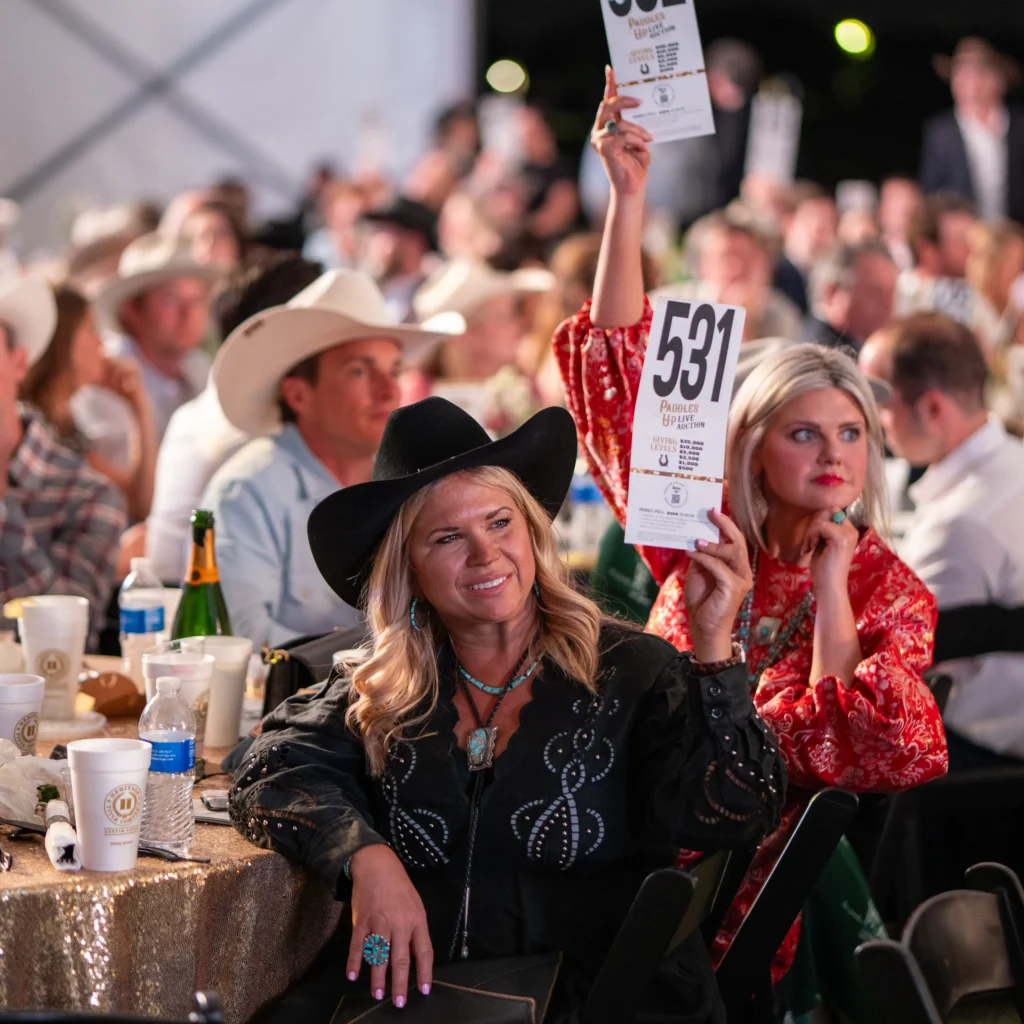
A live auction changes the entire equation, because it’s the one part of the evening built specifically to ask for more, and to make guests want to give it. Instead of a flat ticket price, guests are competing against each other for something they actually want, and the energy of that competition pushes the final price well past what any one person walked in willing to pay. Researchers who study auction behavior call this competitive arousal: once bidding narrows down to a handful of people who genuinely want the same thing, the room’s emotional pull takes over from rational calculation, and prices climb in a way a fixed ticket price never could.
That mechanism doesn’t exist anywhere else in a typical gala program. A raffle sells chances at a fixed price. A silent auction generates real revenue but without the room-wide energy of an auctioneer building a bidding war live. A live auction, sized right, usually five to nine well-chosen lots, and run by someone who knows how to read a room, is the one moment in the night specifically engineered to convert the goodwill you’ve already built into real dollars.
The Same Gala, Two Very Different Outcomes
To see how much this actually matters, picture the exact same gala run two different ways. Two hundred and fifty guests, tickets priced at $200, and $50,000 in production costs for the venue, catering and entertainment. Sponsorship brings in another $25,000 before the night even starts. (These numbers are illustrative, built to make the arithmetic clear, not a real client’s actual figures.)
Run that gala as a party alone, tickets, sponsorship, dinner and a great band, and you net somewhere around $25,000 once the bills are paid. That’s not a criticism of the event. It’s simply what a ticketed party generates once you subtract what it cost to throw it.
Add a well-curated live auction to that same room, with the same guests, the same venue, and the same production budget, and the math changes completely. A handful of well-chosen live lots, priced for that specific room, can realistically bring in six figures on their own. Add a fund-a-need right behind it, and total net revenue often lands well over $200,000, even after covering what it costs to bring in a professional to run it. Same night. Same room. Same guests. The only variable that moved was whether a real auction was part of the program.
You’re Not Trading the Party for the Fundraiser
The instinct I run into most often is the fear that adding a serious auction will somehow make the night feel less like a celebration and more like a sales pitch. It’s the opposite, when it’s done right. Your guests are already gathered together, they’ve shared a meal and a story about your mission, and there’s a current of emotional momentum running through the room before the first item ever goes up.
A skilled auctioneer doesn’t interrupt that momentum, they channel it. Visible bidding creates social participation, competition keeps even non-bidders leaning in to watch, and a strong run of lots builds its own energy that carries straight into whatever comes next on the program.
The Fund-a-Need Gives Every Guest a Way In
A live auction won’t be for everyone in the room, and it doesn’t need to be. This is exactly why I always plan the Raise the Paddle (or sometimes called fund-a-need) alongside it rather than treating it as a separate agenda item handed off between vendors. A paddle raise doesn’t depend on procuring items or building a lineup months in advance.
Every single guest can participate, regardless of whether they bid on anything else that night, and structured giving levels let people at every capacity find a number that feels right for them. With no item changing hands, the story you tell right before the paddles go up is doing as much fundraising work as anything else on your program. Between the two, you’ve built a night that gives your highest-capacity donors a real fight to win and gives everyone else a real way to give, and neither one costs you anything the party wasn’t already paying for.
Not Every Gala Is Ready for a Full Live Auction Yet
A first-year gala, or a room without an established base of high-capacity donors, might not be able to support a full five-to-nine-lot live auction on day one, and that’s fine. A strong silent auction, a modest raffle, a game like heads or tails, or a fund-a-need built entirely on storytelling can still meaningfully outperform ticket sales and sponsorship alone while your donor base and your inventory grow into a live auction over the next few years. The goal was never to force a mechanism your room isn’t ready for. It’s to make sure your gala has at least one moment built specifically to ask for more than the ticket price covered.
Bring This Gap to Your Next Board Conversation
If your organization already runs a gala, the numbers above are worth checking against your own event before you start planning the next one.
- What did last year’s gala actually net, once production costs came out, and how much of that net came from ticket sales and sponsorship versus a genuine auction or fund-a-need?
- How many live lots did you run, and did they feel like a real fight or a formality?
- Was the person calling the auction a trained professional, or someone doing their best without the experience to build real competitive energy in the room?
- Was the auction placed where the night’s energy was actually at its peak, or squeezed in wherever there was room left on the schedule?
The answers to those four questions will tell your board more about your gala’s real fundraising ceiling than any comparison of formats ever could.
If You’re Ready to Add a Real Auction to Your Gala
None of this means you need to rebuild your gala from scratch. Most of what makes a night wonderful, the venue, the food, the entertainment, the way it brings your community together, stays exactly the same. What changes is whether one part of that evening is built specifically to raise real money instead of just covering its own costs.
If you’re planning your next gala and want to know what a real auction could add to a night you’re already building, I’d love to talk it through with you. Reach out and let’s talk it through.
Where auction performance meets purpose
Turn Your Gala Into a Real Fundraiser
Biddy Up helps nonprofits keep the night their guests love while adding the live auction and fund-a-need strategy that actually funds the mission.
Start the Conversation Explore Services