
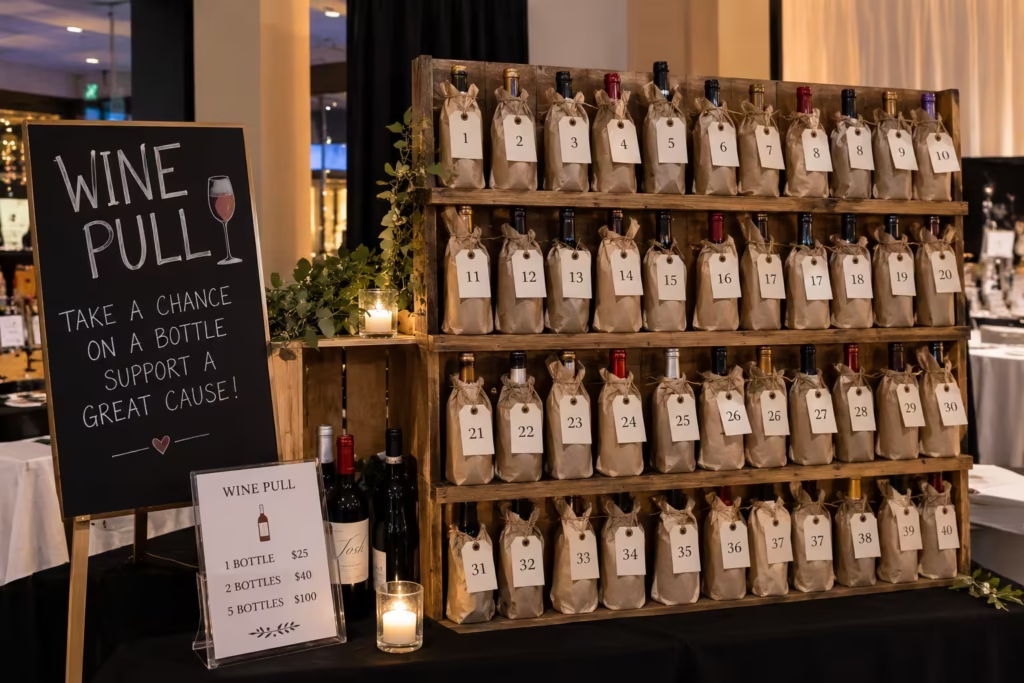
A wine pull is one of the easiest ways to raise money at a charity gala before guests even sit down for dinner. But when it’s done well, it does something else too.
It gets people spending early.
By the time I step up to the podium for the live auction, guests have already said yes to supporting the cause at least once. That makes a difference to the energy in the room.
Since 2017, I’ve worked with more than 100 nonprofits and helped raise over $22 million from the auction stage. In my experience, galas that run a well-priced wine pull during cocktail hour tend to go into the live auction with a warmer, more engaged room.
What Is a Wine Pull?
A wine pull is a charity fundraising game where guests pay a flat price to choose a bottle of wine at random, without knowing what they’re getting until they’ve paid. Most bottles on the wall are worth roughly what the guest paid, and a handful are worth far more, so every pull comes with a small chance of walking away with something special.
You’ll also hear it called a wine wall fundraiser, or just a wine wall, and that’s the same game under a different name. “Wall” just refers to the display, usually a rack or a wall of crates holding every bottle in rows, so the whole collection is visible from across the room.
There are two common ways to run one. In the wrapped version, each bottle is hidden inside a paper bag or a fabric wine sleeve, and the guest pulls the bottle itself. In the numbered version, guests draw a cork or a ticket from a bowl, and the number on it matches a bottle on the wall. Wrapped bottles look better and feel more like opening a present, while numbered corks are faster to run through a crowded cocktail hour and make it easier to keep premium bottles on display, where guests can see what they’re playing for.
For twists like a ring toss or a golden bottle with a bonus prize attached, see how charity gala activations set up a bigger auction night.
How Many Bottles Do You Need for a Wine Pull?
Plan on one bottle for every three guests. A gala of 150 people needs about 50 bottles, and a room of 300 needs about 100.
Not every guest will buy a wine pull, but some will buy two or three, and couples often share one. One bottle per three guests is usually enough to sell out the wall by the end of cocktail hour without leaving a pile of unsold bottles in the back. Selling out is the goal, because an empty wall tells the room people are joining in.
Within those 50 bottles, I like to see a mix that looks something like this: around 40 good everyday bottles worth about $15 each, seven mid-tier bottles in the $30 range, and three genuinely premium bottles worth $75 or more. Those last few are the ones that get guests buying a second pull, and they’re the bottles I call out from the microphone when someone lands one.
How to Price a Wine Pull So Every Bottle Makes Money
Set your pull price just above the average value of the bottles on your wall. Every pull then brings in slightly more than the value of the bottle walking out the door, and the game still feels fair to the guest, who gets their money’s worth on average with a real chance of doing much better.
The math takes about two minutes. Add up the retail value of every bottle on the wall, divide by the number of bottles to get your average, and then set your price roughly 20 to 25 percent above that average, rounded to a clean number that’s easy to pay.
Using the 50-bottle mix from above, forty bottles at $15 comes to $600, seven at $30 comes to $210, and three premium bottles at $80 add another $240. That’s about $1,050 in wine, or an average of $21 a bottle, which puts your pull price at $25-$30.
| Average bottle value | Suggested pull price |
|---|---|
| $15 | $20 |
| $21 | $25 |
| $30 | $35 to $40 |
| $50 | $60 |
The premium bottles are the part people forget. They pull your average up, so you have to count them when you set the price, rather than treating them as a bonus sitting on top of an otherwise cheap wall. If you price a wall full of $15 bottles at $20 and then add three $100 bottles without adjusting, you’ve quietly given away your margin.
Bundles are a good way to lift the average spend, as long as the math still holds. Three pulls for $70 works on a $21-average wall because it still comes in above three times the average bottle value. Three for $60 doesn’t, however generous it looks on the sign.
I’d resist pushing the price much higher than this, even at a black-tie event. The wine pull is meant to be the first small yes of the evening, something every guest can say yes to without thinking twice, because the big giving happens during the live auction and that’s where I want your guests’ generosity at full strength. If you’re still deciding how to build that part of the night, I’ve written about how many live auction items to include.
Sourcing the Wine: Why Donated Bottles Make the Pull So Profitable
Where the wine comes from matters even more than the price. Using the same 50-bottle wall at $25 a pull, a sold-out night brings in $1,250. If your committee bought all of that wine at retail, about $1,050 of it went straight back out on bottles, leaving you roughly $200 for the cause. If the wine was donated, very nearly the whole $1,250 goes to your mission, from exactly the same wall and the same guests.
Ask a Vineyard or Winery
Wineries are the best single source I know of for a wine pull, because a case or two of their bottles costs them relatively little and puts their label in the hands of a room full of people who like wine and have money to spend on it.
When you make the ask, you can give them something concrete in return, such as their name on the signage above the wall and a mention from the stage when one of their bottles gets pulled. Send the request with enough time before your event, be specific about how many bottles you’re hoping for, and tell them how many guests will be in the room, because a winery can say yes to a clear, specific request far more easily than to a vague one.
Ask Distributors and Retailers
A local wine shop or distributor may not be able to donate outright, but many will offer a case discount to a nonprofit, and that alone widens your margin. It’s also a sensible way to fill in the premium tier if your donations lean toward everyday wines.
Ask Your Board and Committee
The simplest ask of all is to your own people. Ask every board and committee member to bring two bottles with a minimum retail value, somewhere around $15, so the wall doesn’t fill up with bottles nobody wants to take home. Some organizations turn this into a “stock the wall” party a few weeks before the gala, where the price of entry is a bottle.
Is a Wine Pull a Raffle?
In most cases a wine pull is treated as a donation in exchange for an item rather than a raffle, because every guest who pays walks away with a bottle, whereas a raffle sells a chance at a prize you might not win. The way you run your pull can blur that line, though, and if you sell tickets and draw numbers for bottles later in the night, it starts to look a lot more like a raffle.
Raffle and alcohol rules vary from state to state, so it’s worth a quick check of your local guidelines before the night, and your venue or caterer can usually tell you what their liquor license covers.
Staffing and Setting Up the Wall
A wall of 50 to 75 bottles runs comfortably with two or three volunteers. One handles payment, whether that’s a card reader or a QR code linked to your auction software, one manages the pulls and keeps the line moving, and the third works as a runner.
That runner matters more than most committees realize, because the single best thing you can do for a wine pull is set up a pickup station. Instead of handing guests their bottle on the spot, tag each one with the guest’s bidder number and hold it for collection at checkout. Otherwise you end up with a ballroom full of people juggling wine bottles when they should have a paddle in their hand for the live auction, and bottles left on tables tend to get knocked over or forgotten.
Put the wall somewhere guests pass on their way in, never in a back corner, and make the price large enough to read from a few steps away.
Where the Wine Pull Fits in Your Gala Program
The wine pull belongs in cocktail hour, from the moment the doors open until guests take their seats, and it should close before the program begins. That window is often the flattest part of the evening, and the wall gives guests something to do and someone new to talk to while they wait.
You can also help sells from the stage. When a guest pulls one of the premium bottles, have your emcee announce it over the microphone, and within a couple of minutes there’s a small crowd at the wall, all hoping to pull the next one. Just before we move everyone to their seats, give a last call for the wine wall, which usually clears the final few bottles in a hurry.
From there, the evening builds on that early momentum, with a quick heads or tails game, another of my favorite gala fundraising games, right before the live auction, the live lots themselves, and then the paddle raise. If you’re mapping out that order for your own event, I walk through it in detail in Building a Charity Gala Program.
If you’re planning a gala and want your wine pull, your program, and your live auction working together from the first pour to the final paddle, get in touch. I’d love to hear about your event and help you build a night that raises more for your mission.
Where auction performance meets purpose
Turn Your Wine Pull Into the Warm-Up for a Bigger Auction Night
Biddy Up helps nonprofits plan every fundraising moment of the gala, from the first bottle pulled at cocktail hour to the final paddle raised in the live auction.
Start the Conversation Explore Services