

Of everything I add to a gala program, a heads or tails game fundraiser is one of the things that board members and committee chairs bring up first when they call me about next year’s event.
It only takes about five minutes on the clock, but in the hundred-plus galas I’ve called since 2017, it has consistently done more to fill the gap between cocktail hour and the live auction than almost anything else on the run of show. Instead of dead air while the room finds its seats, you get every guest standing, laughing, and reaching for their wallet before the first live lot even comes up.
What a Heads or Tails Game Fundraiser Actually Is
Heads or tails is a coin-toss elimination game that guests pay to enter, usually through a wristband or token, with a single prize going to whoever is left standing at the end.
It works because it strips fundraising down to something almost anyone can win in under five minutes, with no bidding knowledge or deep pockets required. This is exactly why it plays so well with guests who might never raise a paddle during the live auction but will happily throw twenty dollars at a coin flip.
How to Run the Game
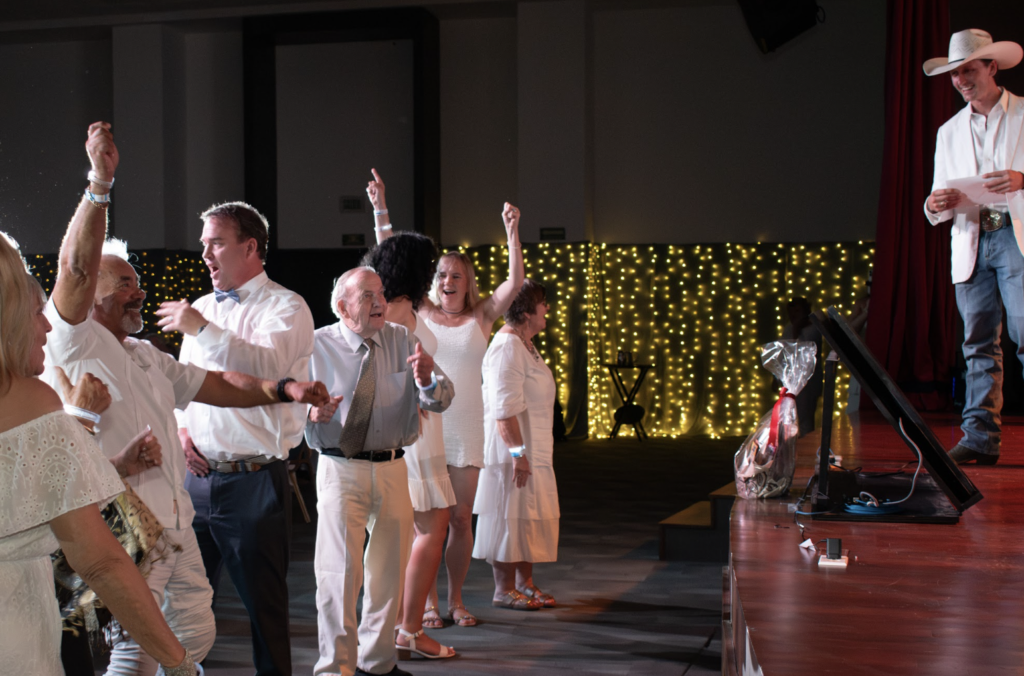
The mechanics are simple enough that I can teach a ballroom full of three hundred guests in under a minute. Everyone who’s bought in stands up, and on my count they put their hands on their head or hands on their behind (signaling their choice for ‘heads or tails’), whichever side they’re betting on, before I flip a coin and call the result. Guess wrong and you sit back down; guess right and you’re still in for the next flip. I keep flipping and eliminating until one guest is left standing, and that guest walks off with the prize.
Whoever is running the game, usually myself as the auctioneer, needs a live mic, a coin big enough for the back of the room to see, and a pace that doesn’t let the room’s energy drop between flips. I aim for a flip every ten to fifteen seconds once the group gets small, because the moment guests have time to think about it instead of react, the game stops feeling like a party and starts feeling like a delay before dinner service.
What guests actually remember isn’t the coin toss itself. It’s the sight of a ballroom full of donors, dressed up and several drinks into the evening, standing on their chairs and cheerily jesting with the person next to them about which coin side to choose.
Why It Generates Real Extra Revenue
Entry pricing usually falls into one of a few tiers depending on the room. A casual or first-year gala tends to do best around ten to fifteen dollars a wristband, a typical mid-size charity gala sits closer to twenty to twenty-five, and a black-tie audience with real disposable income can comfortably support fifty to a hundred dollars a token without anyone blinking.
To see why this adds up fast, picture a gala of two hundred and fifty guests where sixty percent buy in at twenty-five dollars. That’s three thousand seven hundred and fifty dollars raised in a game that costs you nothing but a coin and a prize, before anyone has touched the live auction.
Offering rebuys, letting an eliminated guest pay again for another life back into the game, is where a lot of that revenue can also be generated, because your most competitive and best-heeled guests are exactly the ones who keep buying back in after the first elimination. But be aware that this may be tricky to implement in a large room.
Choosing a Prize That Makes the Buy-In Easy
I’ve handed out everything from a weekend at a lake house to a case of good tequila as the prize for this game, and the pattern holds every time. The entry price only works if the prize looks like a steal sitting next to it. Charge twenty-five dollars a wristband and the prize needs to feel like it’s worth ten times that, or guests will do the math in their head and stay in their seats.
At one black-tie gala where I priced tokens at fifty dollars, the prize was a three-night stay at a boutique hotel, spa package, and champagne dinner included, and the buy in hit almost 70%, because guests could picture themselves using it the following month, not just admiring it from across the ballroom.
The mistake I see most often is a prize that’s impressive on paper but only appeals to a narrow slice of the room, a single round of golf at a private club, say, when half your guests don’t play. A gift card stack, a travel voucher, or cash itself will always outsell a niche experience, because the whole point of this game is that anyone standing in the room can picture themselves wanting to win it. Once word gets around that the prize is worth playing for, guests start chasing down my volunteers to buy in themselves.
How to Sell Entry Tickets
Every event where this game has worked, the ticket system has stayed dead simple. I sell highly visible wristbands or beaded necklaces or tokens during cocktail hour, before the main program starts, so buying in never competes with live auction registration or the paddle raise. A handful of volunteers moving through the crowd with a cash box or a mobile card reader during cocktail hour works really well. Also, having a table captain remind their table to buy in before they sit down catches guests who’d otherwise miss it entirely.
Where Heads or Tails Belongs in Your Gala Program
I place heads or tails right before the live auction starts, never in the middle of it and never straight after the mission moment. The game needs a room that’s loud and on its feet, which makes it a bad match for anything asking guests to sit quietly and feel something first. If you haven’t mapped out where a game like this fits against your paddle raise and your live lots, that’s exactly what I walk through in Building a Charity Gala Program.
Mistakes That Flatten the Energy
The galas where this game under performs almost always share the same handful of problems. The prize doesn’t clear the bar I mentioned above, so guests never feel the buy-in is worth it. The person calling the game rushes it or slows it down too much, so the room loses momentum either way. Nobody promotes it ahead of time, so guests show up without cash or a card handy and miss the window entirely. Or it gets scheduled against something else competing for the room’s attention, like a raffle drawing or a photo moment, which splits guests between two lines instead of one energized crowd.
Can You Run It With a Hybrid or Remote Audience?
If part of your guest list is joining virtually, or you’re running a multi-night version of the game to reach donors who can’t attend in person, you can adapt heads or tails by collecting guesses through a simple form or text-in system and running the coin flips on a set schedule rather than live in the room. It won’t carry the same electricity as three hundred people standing on their chairs, but it does let you extend the fundraiser beyond one night, which is worth considering for donor bases spread across a wider area.
Why Guests Keep Asking for It Back
The message I hear most from board members calling to book me again is some version of “can we do the coin game again.” A gala asks a lot of a guest’s night. Heads or tails is the one moment where nobody in the room is thinking about their table assignment or their next glass of wine, and that kind of unscripted energy is hard to manufacture on purpose. It’s why the game earns a permanent spot on my recommended program almost every time a client asks what to add.
If you’re planning a gala and want to know whether a heads or tails game fundraiser, a paddle raise, or something else entirely fits your room best, reach out and let’s talk it through.
Where auction performance meets purpose
Add a Game That Builds Energy Instead of Killing Time
Biddy Up designs and runs heads or tails and other pre-auction activations that keep the room standing, laughing and ready to bid.
Start the Conversation Explore Services