

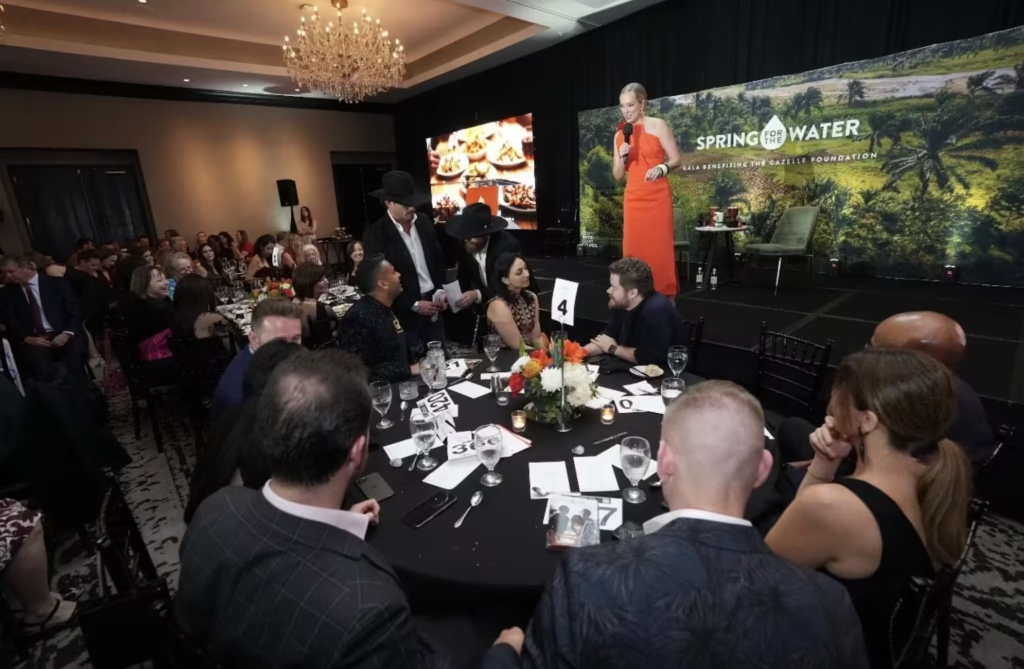
I’ve stood on enough stages to know the exact moment a room changes. I saw it earlier this year at ‘Spring for the Water’, the Gazelle Foundation’s gala for clean water in Burundi, founded by Gilbert Tuhabonye, who grew up in Burundi himself.
We open the live auction the same way every time: with a single glass of water, plain and unremarkable next to the golf trips and extraordinary auction packages that come after it. But it’s exactly the thing the entire night exists to fund. Clean, safe water. And seeing it there, so simply, but knowing it’s so precious to so many adds a huge emotional pull to the room. And, that’s hard to capture. This single glass of water routinely sells for thousands of dollars before we’ve even gotten to anything else.
Give Clean & Safe Drinking Water
“Everybody deserves clean water.”
— Gilbert Tuhabonye
We move through the live auction from there, real items, real competition. But the moment that actually changes the room comes later, once the mission moment plays: a video of Burundi families talking about what clean water changed for them, kids who go to school now instead of walking hours to a river to fetch water their family needed. I’ve watched paddles that sat still through the entire live auction go up the second that video ends, ready to give big during the Paddle Raise.
It’s a small room, not a big crowd by gala standards, and the shift is still completely palpable. I used to chalk that up to luck, or momentum, or just having a good crowd. There’s real research behind why a room full of donors bids and gives the way it does once a story, not a statistic, gets in front of them, and once you understand it, you stop hoping for that shift and start building the night around it.
Why the Story Always Beats the Statistics
The first piece of the psychology is about what gets a paddle in the air in the first place, and here the research runs almost opposite to what most people assume. A well-known study by Deborah Small, George Loewenstein, and Paul Slovic tested a fundraising appeal built around one child, a seven-year-old girl in Mali named Rokia, describing her situation in specific, human terms. Donations to that appeal were strong. Then researchers added statistics to the same appeal, real facts about the millions of children facing similar circumstances, expecting the added context to strengthen the case. Donations dropped. Not because people cared less once they understood the scale of the problem, but because the statistics pulled them out of the emotional, personal register that had made them want to give in the first place and put them into a more analytical one, where the mind starts doing math instead of feeling anything.
Separate research out of Claremont Graduate University, led by neuroeconomist Paul Zak, found a physiological reason this happens. His team measured that character-driven, emotionally structured stories trigger a real release of oxytocin, the same neurochemical tied to empathy and trust, and that the amount released predicted how generous people were willing to be afterward. In a related experiment, participants given synthetic oxytocin donated to 57% more charities and gave 56% more money than a control group. People aren’t being sentimental when a mission moment moves them to bid higher. Something measurable is happening in their bodies that a spreadsheet of impact statistics simply doesn’t trigger.
That’s the case for why a gala needs more than a good time and a nice room. A silent auction table and an open bar will get you a pleasant evening. They won’t get you a room in an emotional state where people are ready to give past their comfort zone, because nothing in that setup has done what Rokia’s story did or what a mission moment video is built to do.
Bringing the Mission Into the Room, Without Making Anyone a Prop
This is the part I’m careful about, because there’s a real difference between showing a room why the work matters and using someone’s hardest moment as a fundraising tool. I don’t build mission moments around despair. I build them around a specific person and what actually changed for them, which almost always means showing progress, not just need. A student talking about the scholarship that got them into a program they’re now thriving in lands harder than a general statement about how many students need help, and it does that without asking anyone to perform their pain for a room of strangers.
If a beneficiary is willing to speak, that person should be telling their own story in their own words, not being described by someone else on their behalf. And a mission moment works best right before the ask, once the room has already been warmed up by the live auction, not earlier in the evening where its emotional charge has time to fade before it’s needed.
The Psychology Behind Why People Bid at All
That’s the emotional case for a strong mission moment. The other half of the psychology has nothing to do with the mission itself and everything to do with the room, the reason a live auction multiplies whatever emotional state that story just created.
Bidding, especially in a live auction, isn’t really a purchasing decision. Researchers Gillian Ku, Deepak Malhotra, and Keith Murnighan studied this directly in research on what they called “competitive arousal,” using live and internet bidding and survey data from 21 auctions across North America, including the 1999 Chicago Cows on Parade public art auction, where more than 300 fiberglass cow sculptures collectively sold for almost seven times their initial estimates. What they found was that live, in-person bidding produces a physiological state closer to competition than commerce. Rivalry with the person across the room, the pressure of a closing countdown, the visibility of every other paddle in the air, all of it pushes people past what they would have decided was a reasonable price if you’d asked them beforehand, in private, with time to think.
That’s a different mechanism than a silent auction bid sheet, where a guest writes a number in the quiet of their own judgment and walks away. It’s also different from an online-only format. A live auction is bidding as a shared, public act, and that visibility is doing real psychological work. People don’t just want the item. They want to win it, in front of a room that’s watching them do it.
Why This Points Straight Back to a Live Auction
Put those two pieces of research together and you get the real case for building a gala around both a live auction and a mission moment, not just one or the other. The live auction is where competitive arousal drives the highest number on its own, guests bidding against each other in public, visible, real time. The mission moment, placed right after it, takes whatever energy the room has left from that competition and redirects it toward the ask that follows. Neither one replaces the other. A mission moment without a live auction has nothing to build on. A live auction without a mission moment leaves real money on the table at the ask.
I build a live auction into nearly every gala I work, regardless of room size, because that combination, a room that’s been moved and a format that rewards competing for something in front of each other, is where the real money gets raised. What should flex with your guest list is the type and price point of your live items, not whether you include a live auction at all, and not how many lots you run. I keep that number in a lean range, generally five to nine lots, in rooms of 70 and rooms of 800 alike, because that’s what protects the pacing that lets this psychology actually do its work.
The paddle raise that follows a live auction runs on this same energy, which is exactly why I place it right after the live auction closes, while the room is still warm from watching people compete. What is a Paddle Raise? walks through how that timing works in more depth.
I’ve also written before about gala activations and the role they play in warming a room up before the ask ever happens. A mission moment and a well-run activation are doing related work, just at different points in the evening.
Getting the Timing Right for Your Room
None of this works as a formula you bolt onto a program at the last minute. The mission moment, the live auction, the paddle raise, they all have to be sequenced with real intention, and that sequencing is different for every organization and every room. I build that sequence with nonprofits directly, in our planning meetings, because the numbers change a lot depending on whether you get it right.
If you’re planning a gala and want to talk through what your room’s emotional arc should actually look like, I’d love to hear about your event.
Where auction performance meets purpose
Build a Gala That Uses the Psychology, Not Just the Program
Biddy Up helps nonprofits sequence the live auction, mission moment, and paddle raise so the room’s energy peaks exactly when the ask needs it most.
Start the Conversation Explore Services