
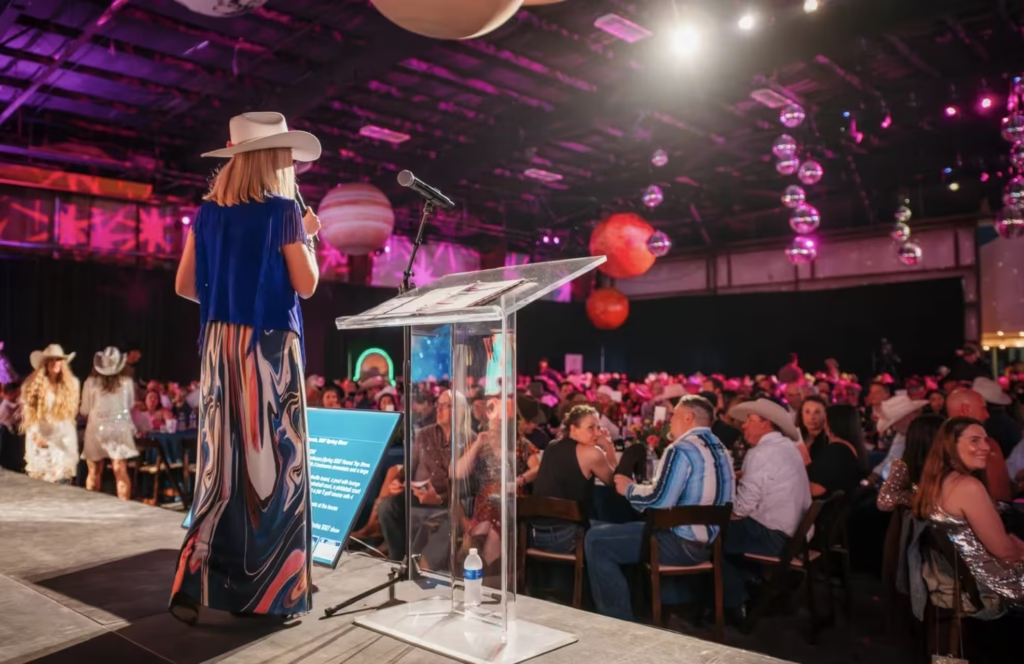
When the last guest has left the gala, the cowboys have hung up their hats, and the bidding paddles are stacked in a box by the stage, we can all smile. It’s been a well-run event, and the impressive final total I announced an hour ago is sitting on a spreadsheet somewhere.
But that final number isn’t money in the bank just yet! A good share of it is still a promise. It might be a winning bid that hasn’t been paid for yet, or a week in a mountain cabin that currently exists only as a printed certificate in somebody’s coat pocket.
I’ve auctioneered for more than 100 nonprofits since 2017, and I’ve seen just how much the weeks after a gala matter. In fact, good post-auction follow-up can make all the difference to next year’s event. The organizations that come back stronger every year tend to get a few things right. They thank people quickly, collect what they’re owed without making anyone feel awkward, and make sure every winning bidder receives what they paid for.
This is the part of the gala that nobody puts on the planning calendar. And once the auctioneer has packed up and gone home, it falls to the charity to do this follow-up. So here’s the plan I give the organizations I work with, along with templates you can copy, adapt and send.
Your Post-Gala Timeline
Follow-up feels overwhelming when it’s one long to-do list, and much more manageable when it’s broken into stages. Most of the work happens in the first week, while guests still remember the room, but it doesn’t really end until you’ve started talking to next year’s donors around the three-month mark.
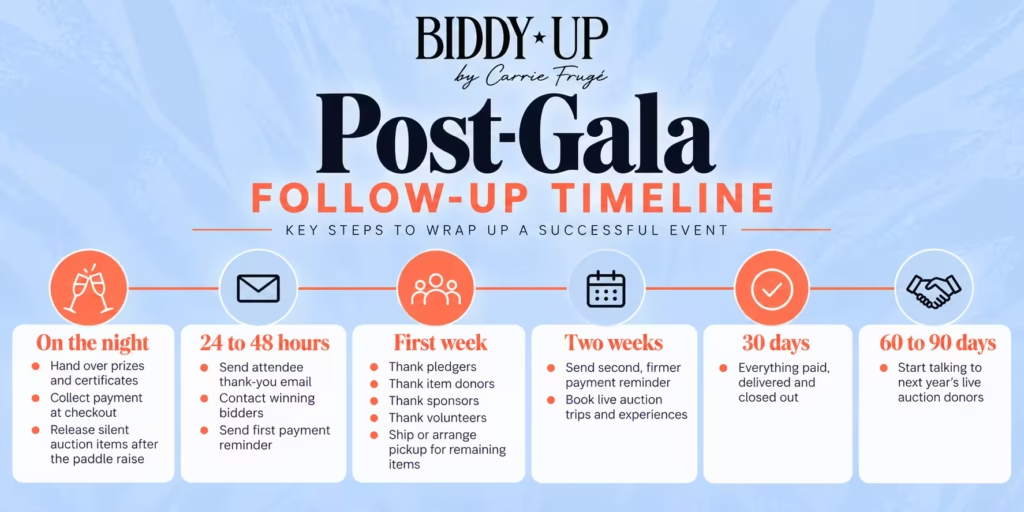
The rest of this post works through each of those stages in order, starting with the one people search for most: what to actually say in your thank-you letters.
Thank-You Letters: Who Gets One and What to Say
A donor thank-you letter doesn’t need to be long or beautifully written to work. What it needs is speed and a sense that a real person sent it. A warm, slightly imperfect email that lands the morning after the gala will do more for your relationship with a guest than a polished letter that arrives three weeks later, when the glow of the night has worn off and they’ve half forgotten what they bid on.
Think about who signs it, too. “The Gala Committee” is nobody in particular, and guests can tell. A thank-you from your executive director or board chair, with a real name and ideally a line or two they wrote themselves, reads as gratitude. The templates below are starting points, so swap in your own details, cut anything that doesn’t sound like your organization, and add a specific memory from the night wherever you can.
Template 1: Attendee Thank-You Email
This is the first email to go out, ideally within 24 to 48 hours, and it goes to everyone who attended. It doubles as your results announcement, so it’s the place to share the total and what that money will do.
Subject: Thank you for an incredible night at [Gala Name]
Dear [First Name],
Thank you for joining us at [Gala Name] on [date]. Together, we raised [$ total] for [organization], and I’m still a little stunned by the generosity in that room.
That money will [specific impact, e.g. keep 40 students in school for a full year / fund our new after-school program]. Every bid and every raised paddle made that possible.
We couldn’t have done it without our sponsors, [Sponsor 1], [Sponsor 2] and [Sponsor 3], or the volunteers who worked all evening to make the night run smoothly.
If you won an auction item, look out for a separate email from us with details on payment and delivery. If you have any questions in the meantime, just reply to this email.
With gratitude, [Name] [Title], [Organization]
Template 2: Paddle Raise Pledge Thank-You
A paddle raise gift is a pure donation, with no item attached, so it deserves its own thank-you. This one also quietly does a practical job: it confirms the amount, which matters when a pledge was made with a raised paddle in a noisy room, and it tells the donor how to pay if they haven’t already.
Subject: Thank you for your gift at [Gala Name]
Dear [First Name],
When you raised your paddle at [Gala Name], you pledged [$ amount] toward [specific mission or project]. Thank you. Gifts like yours are what made that moment in the evening so powerful.
Your gift will [specific impact].
If you’ve already paid, thank you, and you can ignore the next part. If not, you can complete your gift here: [payment link]. Our team is happy to help by phone at [number] if that’s easier.
With heartfelt thanks, [Name] [Title], [Organization]
Template 3: Item Donor Thank-You
The people and businesses who donated your auction items gave you something real, whether that was a week at their beach house or a chef’s table dinner. Thank them warmly and personally, and send this within the first week.
Subject: Thank you for donating to [Gala Name]
Dear [First Name],
Thank you so much for donating [item name] to the [Gala Name] auction. Your generosity helped us raise [$ total] for [organization], and our guests loved it.
Items like yours are what make an auction night exciting, and we’re so grateful you chose to support [mission].
We’d love to keep you updated on the difference your gift is making, and we hope to see you at next year’s gala.
Warmly, [Name] [Title], [Organization]
Template 4: Sponsor Thank-You
Sponsors want to know their support was seen. Remind them where their name appeared, and send any photos you have of their logo on the step-and-repeat or their table sign.
Subject: Thank you for sponsoring [Gala Name]
Dear [First Name],
On behalf of everyone at [Organization], thank you for sponsoring [Gala Name]. Your support helped us raise [$ total] for [mission].
[Company Name] was recognized [where: on stage, in the printed program, on the step-and-repeat, on table signage], and I’ve attached a few photos from the night.
We’d love to talk with you about next year’s partnership when the time is right. In the meantime, thank you for standing behind our work.
With appreciation, [Name] [Title], [Organization]
Template 5: Volunteer Thank-You
Your volunteers ran checkout and stayed long after the guests had gone home. Keep this one short and personal, and if you can mention something specific a volunteer did, do.
Subject: We couldn’t have done it without you
Dear [First Name],
Thank you for volunteering at [Gala Name]. Thanks in part to your hard work, we raised [$ total] for [organization].
[Personal line, e.g. “Our checkout line moved faster than it ever has, and that was down to you.”]
We’re so grateful you gave us your evening.
Thank you, [Name]
Winning Bidders
You don’t need a separate thank-you template for your winning bidders, because the attendee email already thanks them and the payment and delivery emails later in this post do the rest of the work. What winners do need is to hear from you directly, and soon. Treat your live auction and silent auction winners together here.
Within a day or two, contact every winner to congratulate them and confirm what they won, and send the gift certificate, along with terms and conditions that came with the package. That includes expiry dates, blackout dates and any restrictions the donor set. If they didn’t take their item home on the night, tell them exactly how and when they can collect it. A winner who paid $6,000 for a trip and then hears nothing for two weeks starts to wonder whether the trip is real, and that worry tends to follow them to next year’s gala.
A thank-you isn’t a tax receipt
A thank-you letter and a tax receipt do different jobs, so keep them separate. When a guest asks for a receipt, the IRS rules depend on what they gave.
Auction purchases. A winning bidder can only deduct the amount they paid above the item’s fair market value. If someone pays $600 for a beach house week worth $600, there’s no deduction at all. For any payment over $75 that’s partly a gift and partly a purchase, your organization must give the buyer a written statement saying so, with a good-faith estimate of the item’s value. The easiest way to handle this is to list a fair market value for every item in your catalog or on your bid sheets.
Paddle raise pledges and other gifts. For any single gift of $250 or more, the donor needs a written acknowledgment from you showing the amount and date, along with a statement that they received nothing in return.
Item donors. Describe what they donated, but don’t put a dollar value on it. Valuing the item is the donor’s job.
Most organizations send receipts by January 31 of the following year. The IRS covers all of this in Publication 1771 and Publication 526, and it’s always worth checking the details with your accountant.
Collecting Payment and Handling Unpaid Bids
Every auction ends with a gap between the total announced from the stage and the money that actually arrives. Your job in the weeks after the gala is to close that gap as completely as you can, without ever making a supporter feel chased.
Prevention: Take a Card on File at Registration
The single best thing you can do about unpaid bids happens before the auction starts. I recommend every organization I work with take a credit card on file when guests register, either at the check-in table or through your online registration. It turns payment from a favor you have to ask for into a formality, and it means the guest who bids on a trip at 9:30 p.m. and leaves at 9:45 to relieve the babysitter can still be charged without a single awkward phone call.
Guests are used to this now. Explain it simply at check-in (“we take a card so you can skip the checkout line”) and almost nobody minds.
Make Checkout Easy on the Night
The longer the checkout line, the more people decide to “sort it out tomorrow.” Put enough volunteers on checkout and set it up somewhere guests pass on their way out, so paying takes a minute rather than twenty. Let people pay by card or through whatever mobile bidding platform you’re using.
If your silent auction items are released after the paddle raise, which I always recommend so that people stay in the room for the most important ask of the night, make sure checkout is staffed and ready the moment that happens.
When Someone Hasn’t Paid
Most unpaid bids are honest oversights. Usually someone assumed their card had been charged, or the email landed in a spam folder. Start from that assumption, and your follow-up will sound like it.
Set a clear payment deadline, usually seven to ten days after the event, and include it in your first reminder. If the deadline passes, pick up the phone before you send anything firmer. A friendly call from a board member or the development director clears up most of what’s left, and it’s much harder for a misunderstanding to survive a real conversation.
Template 6: Friendly Payment Reminder
Subject: Your [Gala Name] auction item: a quick reminder
Dear [First Name],
Congratulations again on winning [item name] at [Gala Name]! We noticed your payment of [$ amount] hasn’t come through yet, and we wanted to make sure you have everything you need.
You can pay securely here: [payment link]. If it’s easier, call us at [number] and we’ll take care of it over the phone.
We’d be grateful if you could complete your payment by [deadline], so we can get your item to you as soon as possible.
If you’ve already paid, thank you, and please ignore this note.
Warm regards, [Name] [Title], [Organization]
If a second reminder is needed, keep the same warmth but make the deadline firmer and mention what happens next, for example that the item will be offered to the next bidder after a certain date.
If They Still Don’t Pay
Occasionally a winner simply won’t pay, and at that point you have two options. The first is to offer the item to the underbidder, the person who bid just below the winner. It’s the same instinct I use on the night when a donor offers a second package: I’ll offer it to the runner-up straight from the stage, and the cowboys confirm it with them in the crowd. Underbidders wanted the item badly enough to bid on it, and many will happily take it at their last bid.
The second option is to quietly let it go. If the amount is small or the person matters a great deal to your organization in other ways, writing off one auction item can be the wiser choice. Whatever you decide, don’t make it public and don’t let it sour the relationship.
Unpaid Paddle Raise Pledges
Pledges need a gentler touch than auction purchases, because they’re gifts rather than purchases and nobody walked away with anything. A pledge reminder should read as a thank-you first, with the payment details second, which is exactly how Template 2 is written.
If a pledge still hasn’t come in after a month, a personal call from someone the donor knows is far better than a third email. Sometimes circumstances have changed, and a gracious conversation now keeps the door open for a gift next year.
Delivering Auction Items
The moment a winner pays, the clock starts on getting them what they bought. This is where a lot of organizations lose goodwill without realizing it, because a delayed or confusing handover takes the shine off an item someone was thrilled to win.
Template 7: Payment Received and Collecting Your Item
Send this as soon as payment clears. It confirms the money arrived and tells the winner exactly what happens next.
Subject: You’re all set: collecting your [item name]
Dear [First Name],
Thank you! We’ve received your payment of [$ amount] for [item name], and we’re so glad it’s going to you.
Here’s how to receive your item: [Pickup: Your item is ready to collect from [address] between [dates and times]. Please bring this email with you.] [Shipping: We’ll ship your item to [address on file] by [date] and send tracking details once it’s on its way.] [Experience or trip: Please contact [donor name] at [email/phone] to book your dates. Remember that the package must be used by [expiry date], and [blackout dates or restrictions].]
If anything changes or you have questions, reply to this email and we’ll help.
Thank you again for supporting [organization], [Name] [Title], [Organization]
Silent Auction Items
Most silent auction items should go home on the night. Release them once the paddle raise is finished, with volunteers ready at checkout to match winners to their items, so guests leave with their gift baskets under their arms.
For anything left behind, set a pickup window of a week or two at a convenient location and stick to it. If you offer shipping, decide in advance who pays for it and say so in your auction terms. Shipping a framed print across the country can eat into what it raised, so it’s perfectly reasonable to ask the winner to cover the cost.
Live Auction Trips and Experiences
This is the high-stakes part of follow-up, and it deserves the most care. Your live auction items are usually your biggest earners, and they’re often experiences rather than objects: a week at a vacation home or a private dinner cooked by a local chef. Nobody can carry those home in a gift bag, so the handover takes more thought.
Start on the night. Every live auction winner should leave with a printed certificate describing their package, so they have something to hold and show off before they’ve even reached the parking lot. That certificate should also spell out the details that cause the most trouble later on, especially the expiry date and any blackout dates. If the experience has to be booked a set time in advance, say so on the certificate too. If your travel packages involve flights or hotel stays, list exactly what’s included and what isn’t.
Within the first week or two, introduce the winner to the person donating the experience by email, so they can arrange dates directly. Then stay in the loop. Check in with the winner after a month or so to make sure the booking actually happened, and again after the trip or dinner to ask how it went. Those check-ins catch problems early, like a donor who has gone quiet or a vacation home that turns out to be booked solid all summer, and they often turn up a lovely story you can share with your supporters, with the winner’s permission.
When a live auction experience goes smoothly from the certificate on the night through to the photos afterward, both the winner and the donor remember it. That matters more than you might think, because it’s exactly the conversation you want to be having when next year’s gala comes around.
Good Follow-Up Builds Next Year’s Live Auction
When I sit down with an organization to plan a gala, one of the first things we talk about is the live auction, because that’s where the biggest money is raised in the shortest time. And the strongest live auction lots almost always come from the same place: someone who donated last year and had such a good experience doing it that they want to do it again.
That’s why follow-up matters so much. The donor who lent their lake house and got a heartfelt thank-you, then heard from a delighted winner who had the best week of their summer there, is the donor who says yes when you call about next year. The donor whose package sat unclaimed for eight months, or who never heard a word after the gala, is much harder to ask a second time.
So don’t let the conversation go cold. Somewhere between 60 and 90 days after the gala, once the payments are in and the trips are booked, reach out to your best item donors and sponsors personally. Thank them again, sharing a photo or a quote from their winner if you have one, and ask whether they’d consider donating for next year. Starting that early gives you time to secure the kind of headline lots that make a room lean forward, and it gives your donors time to plan something special. If you’re starting to think about what makes a strong lot, our guides to the best live auction items and planning a charity gala auction are good places to start.
The gala itself is one night, but the relationships you build in the weeks afterward are what carry your auction from one year to the next. If you’d like help planning a live auction that raises more for your mission, get in touch and let’s talk about your next event.
Where auction performance meets purpose
Give Your Donors a Live Auction Worth Following Up On
Biddy Up brings professional charity auctioneering and live auction strategy to your gala, so the night raises more and the relationships you build afterward have something real to stand on.
Start the Conversation Explore Services