
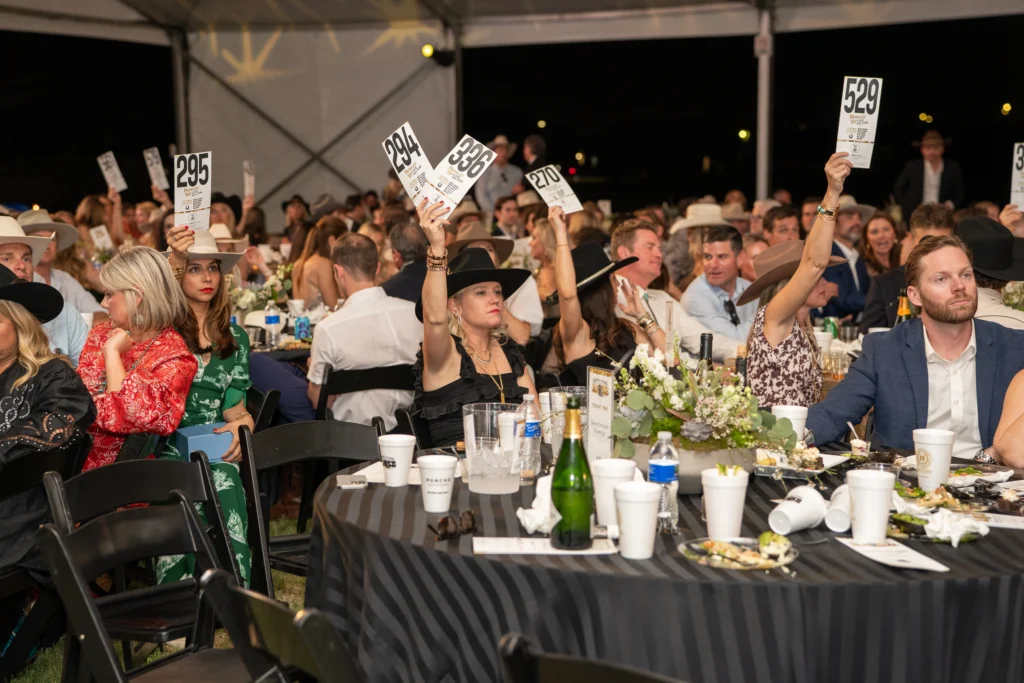
I give the same five pieces of advice to nearly every client I work with, regardless of guest count, venue, or cause. A recent analysis from BetterUnite, an event and auction platform, looked at nearly 400 spring 2026 galas and close to 90,000 confirmed bids. Their findings line up closely with what I already push clients toward on every event, and it’s worth walking through why the data backs each recommendation.
1. Put Your Effort Into the Live Auction, and Open It With Real Experiences
BetterUnite’s data found that live auction items made up just 6% of everything offered across the events they studied, yet those items drove 59% of total revenue. The median live item sold for $2,500. The median silent item sold for $120. The top sellers in their data set were travel and once-in-a-lifetime experiences from top to bottom: an elite private dining experience at $200,000, a London music experience at $110,000, a Tuscany villa escape at $100,000. Not one was a physical item.
Most committees spend the bulk of their sourcing energy on the silent catalog and treat the live lineup as something the auctioneer will sort out later. That ratio should run the other way. A handful of genuinely special experiences, sourced early and merchandised well, will out-earn a much larger table of donated goods almost every time.
2. Skip the Rigid Bidding Formula and Trust Your Auctioneer to Build the Room
The data shows how easily a fixed number can backfire. Starting bids set at 60% or more of an item’s value drew an average of 5.5 bids. Starting lower drew closer to 8.3. Bid increments moved the outcome even harder: the same kinds of items closed at an average of $931 with small increments and just $210 with large ones.
That’s exactly why I don’t hand a committee a formula to print in the program. A live auction calls for a professional in the room reading that specific crowd and adjusting pace and increments as the bidding actually happens, pushing when the energy is there and easing off when it isn’t, not a spreadsheet decision locked in months in advance. No printed rule can do that in real time, which is a large part of what a professional auctioneer is actually being hired to do.
3. Leave the Estimated Value Off the Program for Your Showcase Items
In BetterUnite’s data, items listed without a stated value, marked simply as priceless, sold for a median of $210. Items with a printed value sold for a median of $125, a 68% difference. Printing a number tells every guest exactly where the bidding is supposed to stop.
For your true showstopper items, leave the estimated value off the slide and the printed program. You still need a fair market value on record for gift acknowledgment and tax purposes, and that number can live quietly on the back end without ever reaching a guest’s eyes. What guests see should be the experience itself, not a ceiling somebody set for them months before the event.
4. Build In a Breather Before the Live Auction Opens
The live auction deserves a room that has settled in and is paying full attention, not one still finishing dessert or mid-conversation from dinner. I’ve written elsewhere about the full run of show and where this transition belongs, but the short version is this: give the room a clean, deliberate moment to reset between dinner and the live portion rather than sliding straight from one into the other. Dinner is the warm-up. The live auction is the headline, and headlines earn their own introduction.
5. Script the Close Like It’s Its Own Moment
For online and silent bidding, close to a quarter of all bids in BetterUnite’s data landed in the final hour, and 53% of total revenue came in during the final four hours. Without reminders, notifications, or an auto-extend feature that pushes the close out when a late bid comes in, a guest who would have gone higher never gets the chance. That’s real revenue lost to whoever happened to have the fastest fingers at the buzzer.
Script the close the way you’d script any other big moment in the evening. Push reminders as the deadline approaches. Give your MC a countdown line to work with. If your bidding platform offers an auto-extend or similar feature, use it, so a genuine bidding war gets to finish on its own terms instead of getting cut off by the clock.
The Numbers Confirm the Approach
None of this depends on having a bigger donor list or a wealthier room. It depends on mechanics, the kind of decisions available to any organization willing to make them deliberately rather than by default. I’ve built these five recommendations into how I run events for years, and it’s genuinely reassuring to see a data set this size land in the same place.
If you’re planning your next gala and want help applying this to your own room and your own catalogue, that’s exactly the kind of planning I like working through before invitations go out. Reach out and let’s build an auction that earns what it’s capable of.
Where auction performance meets purpose
Build an Auction That Earns What the Data Says It Can
Biddy Up applies data-backed strategy like this to every client’s room, catalogue, and live auction.
Start the Conversation Explore Services