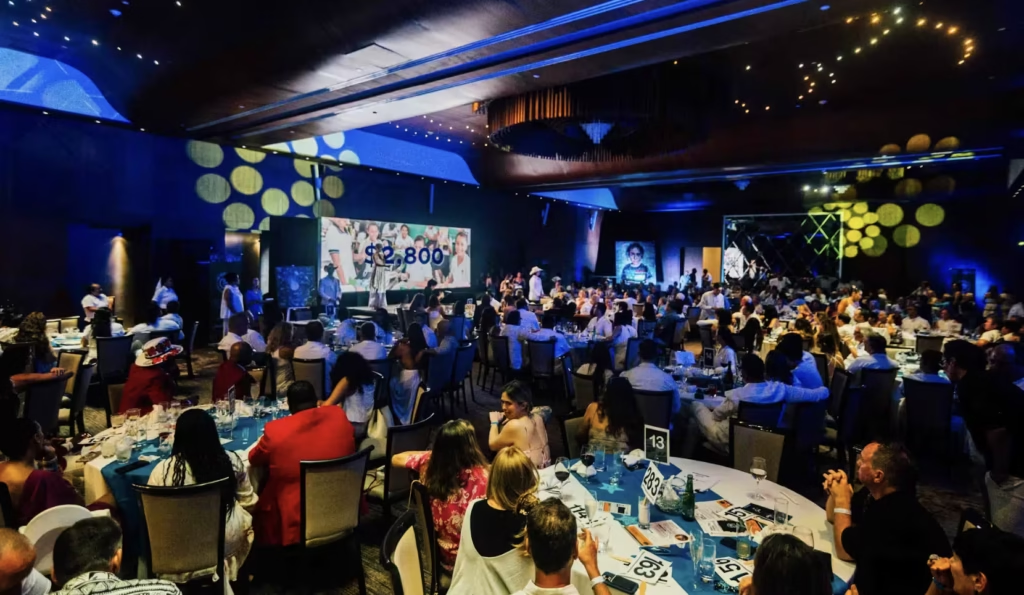
There’s a specific moment in almost every gala I work where the room goes completely quiet. Not the quiet of a lull, the other kind.
Someone has just finished telling the audience exactly why they’re there, and for a few seconds nobody moves. Then I ask the first question, and the first paddle goes up and people give. They give with their entire heart.
That’s a paddle raise, and if you’ve never seen it land the way it’s supposed to, it’s worth understanding exactly what it is, how it works, and why it so often outraises everything else on the program.
What Is a Paddle Raise?
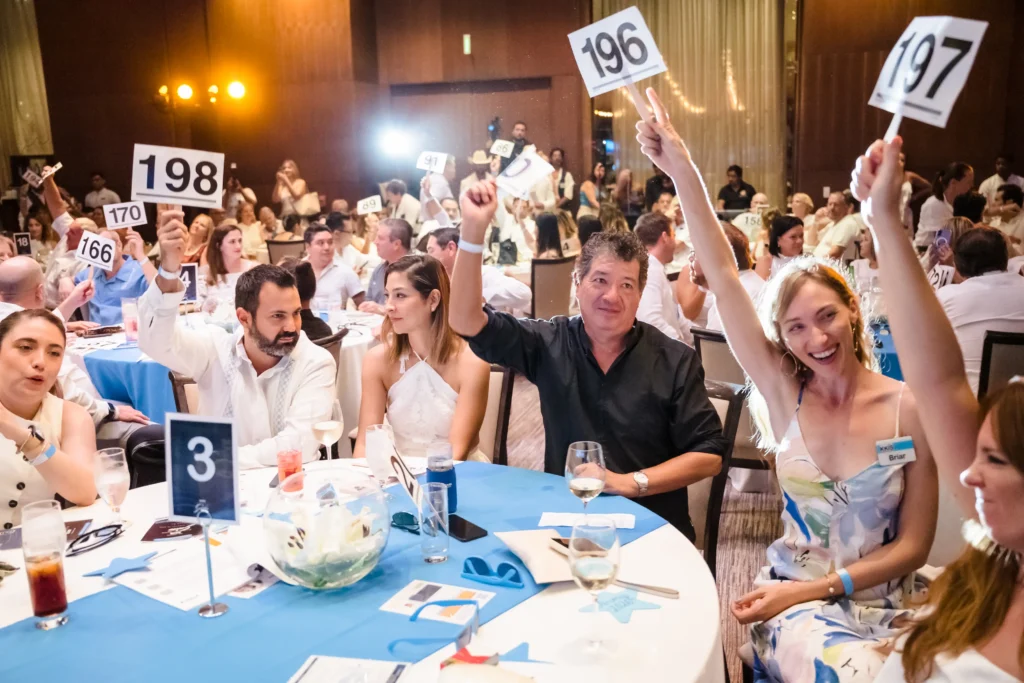
A paddle raise, sometimes called ‘Paddles Up‘, ‘Fund-a-Need’, ‘Cash Call‘, or ‘Special Appeal‘, is the part of a gala where guests donate directly to the cause instead of bidding on an item. Everyone in the room already has a numbered paddle from the live auction, and instead of using it to bid, they raise it to pledge a gift at whatever level I call out. No item changes hands. The donation itself is the point.
Technically, there’s a small distinction between the two names. A paddle raise traditionally supports general operations, money the organization can use anywhere it’s needed, while a Fund-a-Need is tied to a specific project or program. In practice, almost everyone uses the terms interchangeably, and I might do too, because what matters to your guests in the moment is the mission, not the label.
It’s different from anything else on the program because it removes the one barrier that keeps some guests from participating in the auction at all. Not everyone wants a trip to Tuscany or a round of golf with a local celebrity. Everyone in that room, though, can raise a paddle and give, regardless of what’s on the auction block that night.
How Does a Paddle Raise Work?
The mechanics are simple, even though getting them right takes real planning. It starts with a short, specific story, one person, one moment of real impact, told by someone who can speak to it honestly. That’s what shifts the room from polite attention to genuinely leaning in.
From there, I open the ask at the top of a descending ladder. A typical sequence might run $10,000, then $5,000, $2,500, $1,000, $500, $250, and $100, though the exact levels depend entirely on the room and the goal for that night. I’ll call out the highest level first, often a number I already know at least one or two guests are prepared to meet, because when a paddle goes up at the top, it gives everyone else in the room permission to give boldly too.
As I move down through the levels, a spotting team, the same team that works the live auction, tracks every paddle number and pledge amount as it happens, so nothing gets lost in the moment.
Why a Paddle Raise Fundraiser Works So Well
A paddle raise fundraiser succeeds because it asks something different of the room than an auction does. Bidding is competitive. Giving here is collective. Once a few paddles go up, more follow, not because anyone feels pressured, but because generosity is contagious in a room that’s already emotionally invested in the cause.
There’s also a psychological piece worth naming honestly. Guests are used to transactions, paying a price and receiving something specific in return, and a paddle raise asks them to give without getting anything tangible back. What replaces the item is status and belonging. Raising a paddle high enough for the room to see is its own kind of reward, a visible moment of generosity in front of people whose opinion matters to that donor. Understanding that is part of what lets me design the ask so it actually lands instead of falling flat.
It also gives me a clean, immediate read on the night. Unlike a silent auction that takes time to tally, a paddle raise produces a number I can announce before the band even starts playing. That immediacy matters. It tells your guests, in real time, what their generosity just accomplished together.
Timing Changes the Outcome More Than Most Committees Expect
Where the paddle raise lands in the evening matters more than almost any other decision. Push it too late, after the live auction has worn the room down and people are thinking about dessert or getting home, and you lose a meaningful share of what you could have raised.
I generally push to run it while energy in the room is still climbing, which on its own can shift the total by a noticeable margin compared to tucking it in at the end of the night.
Make It a Team Moment, Not a Guilt Trip
The tone of the ask matters as much as the numbers. Donors who feel like they chose to join something give more, and give more happily, than donors who feel cornered into it. My job on stage is to make the room feel like part of a shared effort, encouraging and energetic rather than pressuring, so guests want to raise that paddle rather than feeling like they have to.
The “Ask for a Few More” Technique
One of the most reliable tools in a paddle raise is the incremental landmark. If seven guests have already given at a thousand dollars, I won’t just move to the next level. I’ll ask for three more at that same level to round the room up to ten, a number people can picture and want to be part of completing. Small, specific, achievable asks like that consistently outperform vague appeals to give more.
Keep Score and Say the Number Out Loud
Throughout the paddle raise, you may want to think about keeping a running tally and letting the room know where the total stands.
Hearing the number climb in real time builds its own momentum, and announcing the final figure before the night moves on gives your guests a concrete sense of what they just accomplished together.
You may be able to use this number alongside a ‘sponsor match’ if someone has generously opted to match paddle raises to a certain amount. This helps to drive extra funds too, as people see that the charity gets ‘more’ for their raise.
What Actually Makes a Paddle Raise Raise Money
I’ve run this segment enough times to know it rarely fails because of bad luck. It almost always comes down to one of three things not being in place.
The first is the story itself. It has to be specific. Not a recap of the whole mission, just one real moment that makes the need impossible to ignore. I work with the event team well before the gala to find that story and make sure whoever tells it can do so without sounding rehearsed.
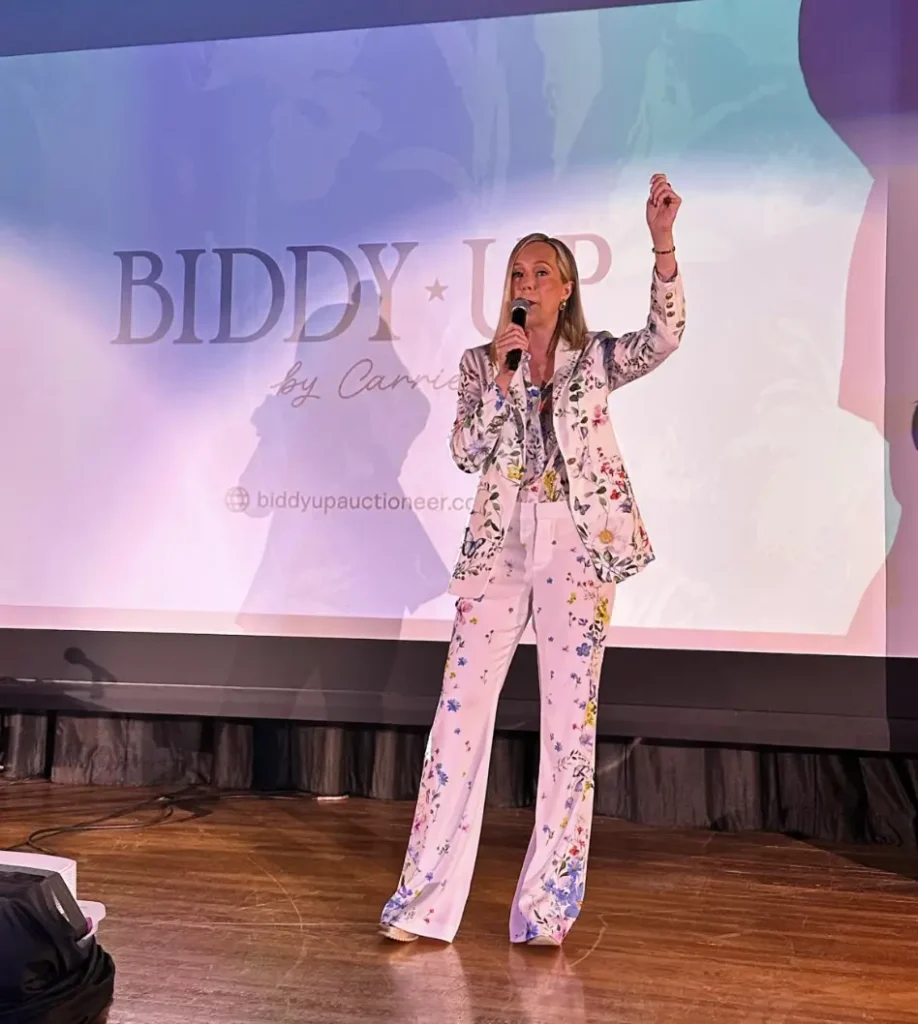
The second is having someone on stage who’s actually trained to run the ask, not just announce it. Reading a room of donors in real time, knowing when to hold a level a few extra seconds because three more paddles are about to come up, knowing when to move on because the room has given what it’s going to give, that’s not something you can script in advance. It’s something I adjust live, every time, because no two rooms behave the same way.
The third is preparation that happens long before the event. I work with my clients to identify a handful of guests likely to lead at the top giving level, because a strong first paddle changes what the rest of the room believes is possible. Seating matters too. A few generous, visible donors seated where the room can see them raise their paddle first does more for momentum than almost anything I say from the stage.
What Gala Partners Say About Raising the Paddle With Biddy Up
“During the auction and Paws Up (‘Paddles Up’ with a theme!) moment, Carrie commanded the room with confidence and poise. Thanks to Carrie and her team, we had the best auction we’ve ever had!“
Tori Villarreal | Emancipet
“She plans and coordinates for months prior, working intimately with the Garden Party Team to choose the perfect live auction lineup and guides us to create the most meaningful paddles up program. Her demeanor and energy perfectly complement the efforts of our most important fundraiser.”
Dale Huggins | Umlauf Garden Party
“[Carrie] and her team bring amazing energy, enthusiasm, experience, and expertise to the entire process. They know how to engage the crowd, read the room, and get those Paddles Up!”
Natalie Brown | The Gazelle Foundation
Every cause I work with has its own version of that quiet moment before the first paddle goes up. If you want help making sure yours becomes the most profitable few minutes of your entire night, I’d love to talk it through.
Where auction performance meets purpose
The most profitable part of your gala may not be the auction.
Biddy Up helps nonprofits design and execute paddle raises that inspire generosity, build momentum, and maximize fundraising results through strategic planning and expert live event leadership.
Start the Conversation Explore Services