
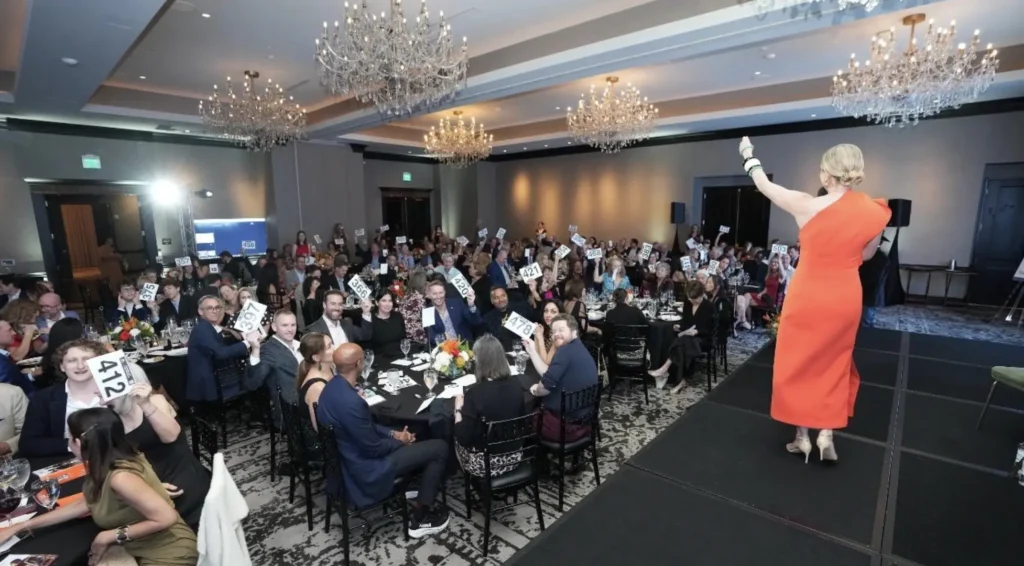
Every charity gala has that moment. The board member steps up to the podium, shuffles a few notes, makes a self-deprecating joke about not being a real auctioneer — and the room laughs politely. Then the bidding starts. And the energy that took your team months to build begins to leak out of the room like air from a slow puncture.
It’s not that your board member isn’t wonderful. (We know that they are truly great and want the best for your event!) It’s that running a live auction is a specific, teachable, experience-built skill — and without it, even the most charismatic of volunteers leaves money on the table.
The Hidden Cost of the “Free” Option
Choosing a volunteer auctioneer often feels like a sensible budget decision. After all, why pay for something a volunteer is willing to do for free? The problem is that most committees only calculate the cost. They don’t calculate the opportunity cost.
A professional charity auctioneer who knows how to read a room, manage bidding momentum, and navigate a stall will consistently outperform a volunteer host — not by a small margin, but by a meaningful one. The difference often pays for the auctioneer’s fee several times over.
Here’s what most nonprofit committees don’t factor in: your live auction will run for 30 to 40 minutes. That’s the window you have to generate the most significant revenue of your entire event. What happens in those 40 minutes is determined almost entirely by who’s holding the microphone.
What a Professional Charity Auctioneer Actually Does
The job starts months before the event, not the night of.
A professional benefit auctioneer reviews your auction packages, advises on sequencing (Yes! The order matters enormously!), helps you set starting bids, and runs pre-event planning sessions to make sure the entire flow of the evening is built to maximize giving. On the night itself, they’re managing the room’s energy in real time: reading body language, adjusting pace, knowing when to push a bid and when to let it breathe.
Moving an exclusive travel package from the first lot to the third can completely change its performance. Placing a Fund-A-Need immediately after an emotional mission moment can add thousands to the total raised. But this is insight that only comes with the experience of being a professional auctioneer, and having raised millions for nonprofits.
They also know how to handle a stall. A room that goes quiet mid-auction isn’t a dead end, it’s a moment that requires a specific response. A volunteer emcee usually panics. A professional redirects.
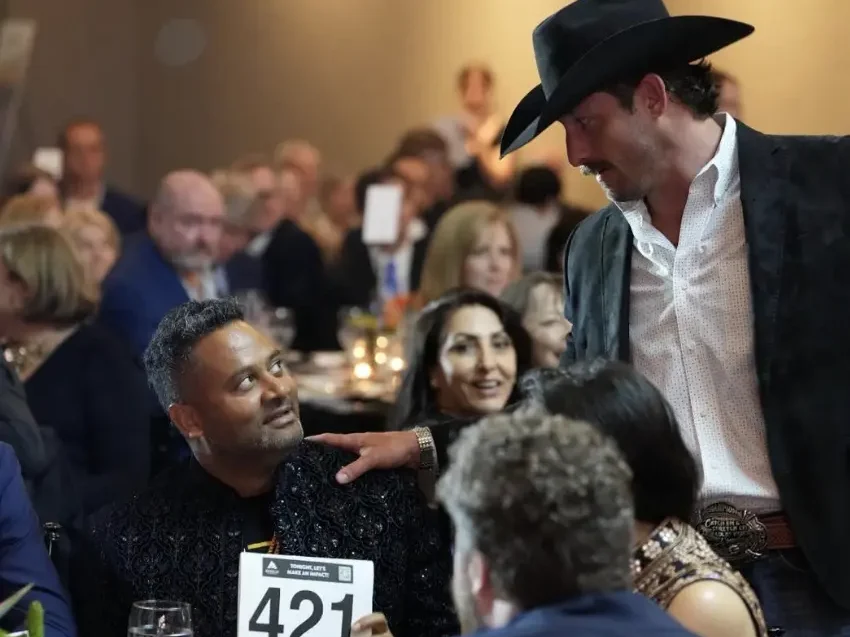
The Biddy Up team brings cowboy-hat-wearing spotters who work the room during the live auction. Not as decoration, but because spotters drive bids. They catch raises at the back of an 800-person room, acknowledge donors publicly, and keep the bidding competitive. They raise MORE MONEY. A volunteer with a gavel and a list of item names simply doesn’t have that infrastructure.
The Volunteer Who Works (and the One Who Doesn’t)
To be clear: there are situations where a volunteer host is a reasonable choice. Many nonprofits have passionate supporters who can be fantastic emcees. The challenge is that being a great host and being a skilled auctioneer are two very different roles
If your event is small: under 50 guests, a handful of auction items, and a close-knit community of donors who already know what they’re giving; warm, well-prepared volunteer can carry the room. If you’re in early-stage fundraising and every dollar counts, the calculus is different.
But if you’re running a gala with 200 or more attendees, a live auction with five or more packages, and a revenue target your mission actually depends on, the “free” auctioneer is rarely the cheaper option.
The Question Worth Asking
Before your committee decides, ask this: what would it mean for your nonprofit if your next gala raised 20% more than last year?
A professional benefit auctioneer who knows how to build momentum, manage a room, and execute a Fund-A-Need paddle raise with genuine emotional impact can move the needle. The investment is a line item. The upside is everything your cause is working toward.
How to Choose the Right Professional
Not all charity auctioneers operate the same way. Some work on a percentage of the take – which aligns incentives, but introduces uncertainty into your event budget. Others, like Biddy Up, work on a flat-fee model: you know your cost up front, and every dollar raised above that goes straight to the mission.
Ask any auctioneer you’re considering: How many nonprofit events have you run? What does your pre-event planning process look like? What happens when we hit a stall in the room?
The answers will tell you quickly whether you’re looking at a professional or a personality.
The best charity auctions feel effortless from the audience’s perspective. What’s invisible is the months of planning, the years of stage experience, and the trained eye that’s reading the room in real time. That’s not something a good-natured volunteer can replicate — and it’s not something your donors will be able to articulate afterward, even as they reach for their paddles.
If you’re weighing your options for your next fundraiser, I’m happy to talk through what your event could look like with the right team behind it.
Where auction performance meets purpose
The right auctioneer can change your fundraising outcome.
Biddy Up partners with nonprofits to create high-performing fundraising events through strategic planning, professional auctioneering, and proven techniques that maximize donor participation and revenue.
Start the Conversation Explore Services